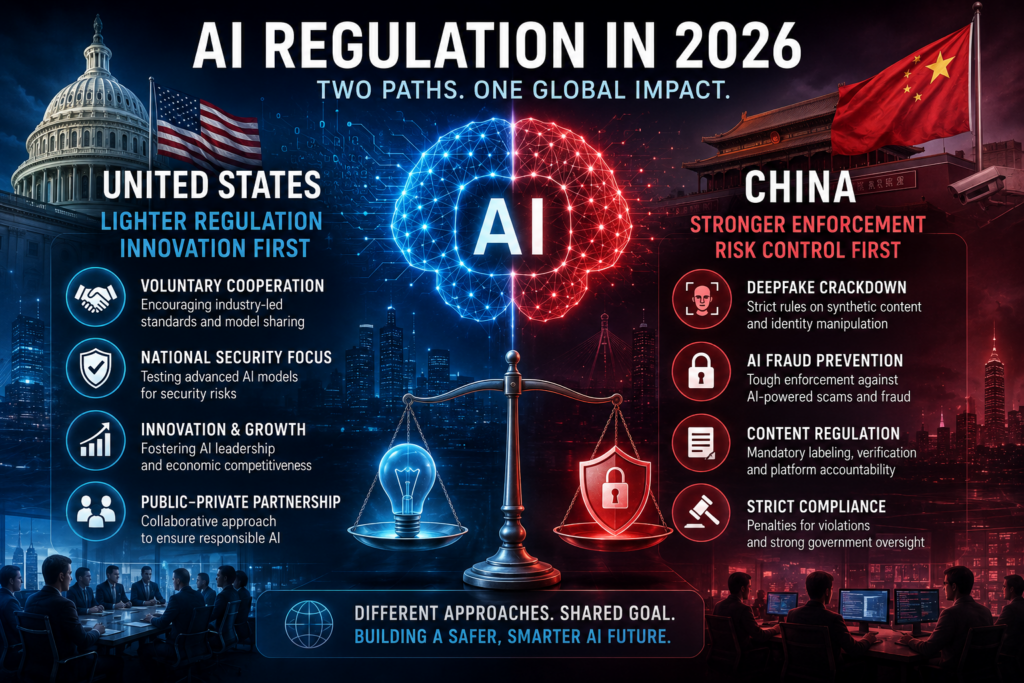


Artificial intelligence has become one of the most strategically important technologies of the 21st century, forcing governments around the world to rethink how innovation should be regulated. In 2026, a notable divergence is emerging between the world’s two largest technology powers: the United States and China.
While the United States is moving toward a lighter regulatory framework focused on innovation, voluntary cooperation, and national security testing, China is intensifying enforcement efforts aimed at combating deepfakes, AI-generated misinformation, and digital fraud.
This contrast highlights two different philosophies for managing the rapid rise of artificial intelligence.
🤖 The Global AI Governance Challenge
Artificial intelligence presents governments with a difficult balancing act.
On one hand, AI offers enormous economic and strategic advantages:
- Increased productivity
- Scientific breakthroughs
- Economic growth
- Military and cybersecurity applications
- Enhanced public services
On the other hand, AI introduces significant risks:
- Deepfake misinformation
- AI-enabled fraud
- Cybersecurity threats
- Privacy concerns
- Potential national security vulnerabilities
As AI capabilities continue to advance, policymakers are seeking frameworks that protect society without slowing innovation.
🇺🇸 United States Favors a Lighter Regulatory Approach
Recent policy discussions in the United States suggest a preference for encouraging AI development rather than imposing strict licensing requirements.
Focus on Innovation
American policymakers increasingly view AI as a strategic technology critical to:
- Economic competitiveness
- Technological leadership
- National security
- Global influence
As a result, regulators appear cautious about introducing rules that could limit domestic AI development.
Voluntary Cooperation Model
Instead of comprehensive licensing systems, the U.S. approach is emphasizing:
- Voluntary safety commitments
- Industry collaboration
- Security testing frameworks
- Transparency initiatives
- Risk assessment standards
This model allows technology companies greater flexibility while encouraging responsible development practices.
🔒 National Security Becomes the Priority
One of the most important shifts in U.S. policy is the growing emphasis on national security testing.
Why Security Testing Matters
Advanced AI models could potentially be misused for:
- Cyberattacks
- Biological research misuse
- Critical infrastructure targeting
- Disinformation campaigns
Rather than requiring government approval before development, policymakers are focusing on evaluating whether frontier AI systems create significant security risks.
Areas of Evaluation
Future testing programs may examine:
- Model capabilities
- Cybersecurity vulnerabilities
- Autonomous behavior
- Risk escalation scenarios
- Misuse prevention mechanisms
This approach seeks to identify dangerous capabilities while preserving innovation incentives.
📊 Voluntary Model Sharing and Collaboration
Another emerging trend is the encouragement of voluntary information sharing between AI developers and government agencies.
Potential Benefits
Voluntary collaboration can help:
- Improve safety research
- Accelerate risk identification
- Support national security planning
- Develop best practices
- Strengthen public-private partnerships
Rather than mandatory disclosure requirements, policymakers are exploring cooperative frameworks that maintain competitiveness while improving oversight.
🇨🇳 China Expands AI Enforcement Efforts


While the United States emphasizes flexibility, China is pursuing a more enforcement-oriented strategy.
Chinese regulators have intensified efforts to address risks associated with AI-generated content, particularly:
- Deepfakes
- Identity impersonation
- Financial scams
- AI-generated misinformation
- Online fraud schemes
The government views these issues as significant threats to social stability and digital trust.
🎭 The Growing Threat of Deepfakes
Deepfake technology has become increasingly sophisticated.
Modern AI systems can generate:
- Realistic videos
- Synthetic voices
- Fabricated images
- Fake public statements
- Convincing digital identities
As the technology improves, distinguishing authentic content from synthetic content becomes more difficult.
Regulatory Response
China has introduced stricter requirements that may include:
- Content labeling
- Identity verification
- Platform responsibilities
- Detection mechanisms
- Enforcement penalties
The objective is to reduce the misuse of generative AI technologies while maintaining control over digital information environments.
💳 AI Fraud Becomes a Major Concern
One of the fastest-growing challenges globally is AI-powered fraud.
Criminals can use AI to:
- Clone voices
- Generate fake identities
- Create fraudulent documents
- Conduct social engineering attacks
- Automate scam operations
Governments increasingly view AI fraud as a direct threat to consumers and businesses.
China’s recent enforcement initiatives indicate a growing focus on preventing financial and identity-related crimes enabled by artificial intelligence.
⚖️ Two Different Regulatory Philosophies
The contrasting approaches of the United States and China reveal two distinct regulatory models.
U.S. Approach
Primary Goals:
- Encourage innovation
- Maintain technological leadership
- Focus on national security
- Promote voluntary compliance
Key Characteristics:
- Flexible regulation
- Industry cooperation
- Security testing
- Market-driven development
China Approach
Primary Goals:
- Social stability
- Content control
- Fraud prevention
- Risk mitigation
Key Characteristics:
- Stronger enforcement
- Mandatory compliance measures
- Platform accountability
- Expanded oversight
Both approaches seek to address AI risks but differ significantly in implementation.
🌍 Implications for Global AI Development
The divergence between major economies could influence AI regulation worldwide.
Countries developing their own frameworks may choose elements from both models.
Possible outcomes include:
Innovation-Focused Frameworks
Some nations may prioritize:
- Startup growth
- Research investment
- Industry self-governance
Safety-Focused Frameworks
Others may emphasize:
- Licensing systems
- Content controls
- Risk assessments
- Compliance requirements
Hybrid Models
Many governments are likely to adopt a combination of innovation support and targeted regulation.
🚀 What Businesses Need to Watch
Technology companies operating globally will face increasing complexity.
Organizations may need to navigate:
- Different national regulations
- Content moderation requirements
- Security testing expectations
- AI transparency obligations
- Cross-border compliance standards
As AI becomes a critical business technology, regulatory strategy is becoming just as important as technical strategy.
🔮 The Future of AI Governance
The regulatory landscape remains highly dynamic.
Over the next few years, policymakers will continue addressing questions such as:
- How should advanced AI models be tested?
- What level of transparency is appropriate?
- How can innovation and safety be balanced?
- Who is responsible when AI systems cause harm?
- How should governments manage AI-generated content?
The answers to these questions will shape the future development of artificial intelligence worldwide.
🎯 Conclusion
The global approach to AI regulation is entering a new phase. The United States appears focused on promoting innovation through lighter regulation, voluntary cooperation, and national security testing, while China is expanding enforcement efforts targeting deepfakes, misinformation, and AI-enabled fraud.
These differing strategies reflect broader policy priorities and could influence how AI develops across the global economy. As artificial intelligence becomes increasingly integrated into society, governments will continue refining their approaches to ensure that innovation, security, and public trust evolve together.