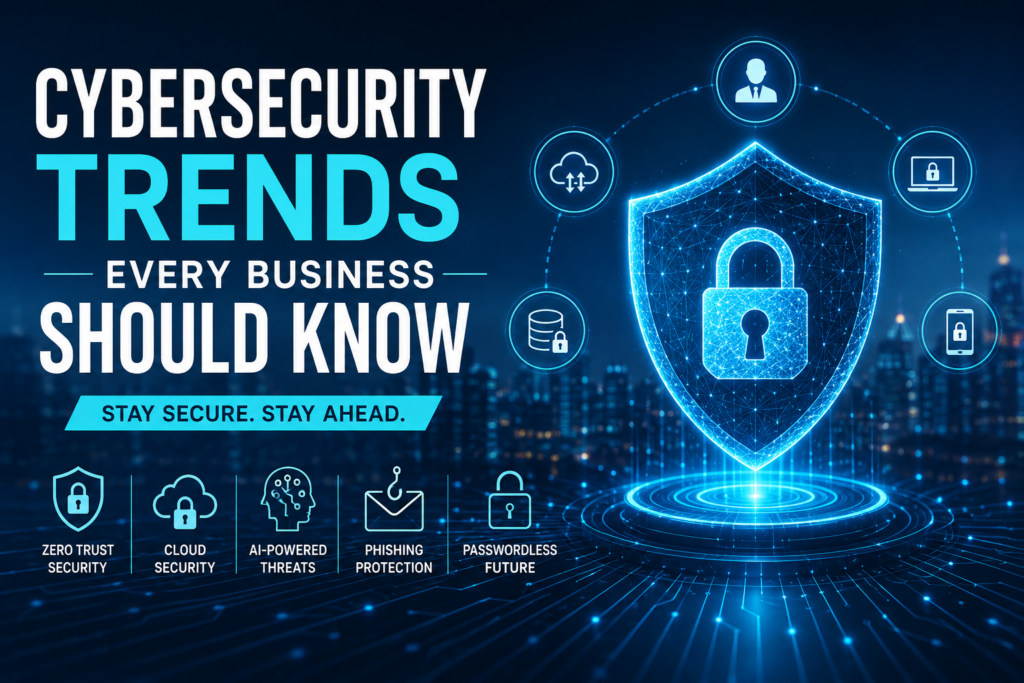
Discover the latest cybersecurity trends every business should know in 2026. Learn about AI-powered threats, Zero Trust, cloud security, ransomware protection, and best practices to keep your organization secure.
📖 Introduction
In today’s digital-first economy, cybersecurity is no longer just the responsibility of the IT department—it has become a fundamental part of every successful business strategy. From startups and small businesses to multinational corporations, organizations of all sizes rely on technology to manage customer data, financial transactions, communication, and daily operations. While digital transformation has created incredible opportunities for growth and innovation, it has also introduced new cybersecurity risks that can threaten business continuity.
Cybercriminals are becoming more sophisticated, leveraging artificial intelligence (AI), automation, ransomware, phishing campaigns, and cloud vulnerabilities to target businesses. According to industry reports, cyberattacks continue to rise every year, causing billions of dollars in financial losses, regulatory penalties, operational disruptions, and reputational damage.
The cybersecurity landscape in 2026 is changing rapidly. Businesses can no longer rely solely on traditional antivirus software and firewalls. Instead, they must adopt proactive security strategies, modern technologies, employee awareness programs, and continuous monitoring to defend against evolving threats.
This comprehensive guide explores the latest cybersecurity trends every business should know, practical strategies for reducing cyber risks, and how organizations can build a resilient security posture for the future.
🌍 Why Cybersecurity Matters More Than Ever
Businesses today generate and store enormous amounts of valuable data. Customer information, employee records, payment details, intellectual property, and confidential business documents are all attractive targets for cybercriminals.
A successful cyberattack can lead to:
- 💰 Financial losses due to fraud or ransom payments
- 📉 Loss of customer trust and reputation
- ⚖️ Legal and regulatory penalties
- ⏳ Business downtime and operational disruption
- 📂 Theft of sensitive business information
For many small businesses, a significant cyberattack can even threaten long-term survival. This makes cybersecurity a strategic investment rather than just a technical expense.
🚨 Top Cybersecurity Trends Every Business Should Know
🤖 1. Artificial Intelligence Is Transforming Cybersecurity
Artificial Intelligence has become both a powerful defense tool and a weapon for cybercriminals.
Businesses use AI to:
- Detect suspicious network activity
- Identify malware faster
- Analyze billions of security events
- Predict potential attacks
- Automate incident response
Unfortunately, attackers are also using AI to create:
- More convincing phishing emails
- Deepfake audio and video scams
- Automated hacking tools
- Intelligent malware that adapts to defenses
Business Tip: Combine AI-powered security tools with regular employee training to improve your organization’s defenses.
🔒 2. Zero Trust Security Is Becoming the New Standard
Traditional cybersecurity assumed that users inside a company network could be trusted. Modern businesses can no longer rely on this approach.
Zero Trust follows one simple principle:
“Never Trust, Always Verify.”
Every user, device, and application must continuously prove its identity before receiving access.
Key features include:
- Identity verification
- Multi-Factor Authentication (MFA)
- Least privilege access
- Continuous monitoring
- Device security validation
This model significantly reduces the risk of insider threats and unauthorized access.
☁️ 3. Cloud Security Continues to Grow in Importance
Most businesses now rely heavily on cloud services for storage, collaboration, and software applications.
However, cloud environments introduce new security challenges, including:
- Misconfigured storage buckets
- Weak authentication
- Insecure APIs
- Data leakage
- Unauthorized user access
Businesses should:
- Encrypt cloud data
- Enable Multi-Factor Authentication
- Perform regular security audits
- Monitor cloud environments continuously
🎣 4. Phishing Attacks Are Becoming Smarter
Phishing remains one of the most successful attack methods.
Modern phishing emails are extremely convincing because attackers use AI to personalize messages.
Examples include:
- Fake invoices
- Payroll scams
- CEO impersonation
- Banking notifications
- Fake login pages
Businesses should train employees to:
- Verify unexpected emails
- Avoid clicking suspicious links
- Confirm payment requests
- Report suspicious messages immediately
Employee awareness remains one of the strongest cybersecurity defenses.
🔑 5. Passwordless Authentication Is Growing
Passwords have always been one of the weakest security links.
Many organizations are now replacing passwords with:
- Fingerprint authentication
- Facial recognition
- Security keys
- Mobile authentication
- Passkeys
Passwordless systems improve both user experience and security.
💣 6. Ransomware Continues to Evolve
Ransomware attacks are becoming increasingly sophisticated.
Modern ransomware groups often:
- Encrypt company files
- Steal confidential information
- Threaten public data leaks
- Target backup systems
- Demand cryptocurrency payments
Businesses should:
- Maintain offline backups
- Patch systems regularly
- Use Endpoint Detection and Response (EDR)
- Test recovery plans
- Restrict unnecessary user permissions
Never assume backups alone are enough—regular testing is essential.
📱 7. Mobile Device Security Is Critical
Remote work has made smartphones and tablets essential business tools.
Common mobile security risks include:
- Lost devices
- Public Wi-Fi attacks
- Malicious applications
- Weak passwords
- Data theft
Organizations should implement:
- Mobile Device Management (MDM)
- Device encryption
- Remote wipe capabilities
- VPN access
- Biometric authentication
🌐 8. Supply Chain Attacks Are Increasing
Businesses rely on numerous third-party vendors and software providers.
Attackers increasingly target suppliers because compromising one vendor may provide access to hundreds or thousands of businesses.
Before partnering with vendors, companies should:
- Evaluate cybersecurity practices
- Review compliance certifications
- Monitor third-party access
- Conduct periodic security assessments
Supply chain security has become a critical part of enterprise risk management.
👨💼 9. Human Error Remains the Biggest Cybersecurity Risk
Despite advances in technology, employees remain one of the most common causes of cybersecurity incidents.
Examples include:
- Weak passwords
- Sharing confidential information
- Falling for phishing scams
- Misconfigured cloud storage
- Using unauthorized software
Regular cybersecurity awareness training helps employees recognize and avoid common threats.
📊 10. Continuous Monitoring Is Replacing Traditional Security
Cybersecurity is no longer about installing antivirus software and hoping for the best.
Modern organizations use:
- 24/7 threat monitoring
- AI-based detection
- Security Information and Event Management (SIEM)
- Extended Detection and Response (XDR)
- Automated incident response
Continuous monitoring enables faster detection and reduces the impact of cyberattacks.
🚀 Conclusion
Cybersecurity in 2026 is about much more than preventing hackers from accessing your systems. It is about protecting customer trust, ensuring business continuity, complying with regulations, and building long-term resilience in an increasingly connected world.
Businesses that invest in modern cybersecurity practices—such as Zero Trust security, AI-powered threat detection, cloud protection, employee awareness training, and continuous monitoring—will be better prepared to defend against evolving cyber threats.
No organization is completely immune to cyber risks, but a proactive approach can significantly reduce vulnerabilities and improve response capabilities. As technology continues to evolve, cybersecurity should remain a top priority for every business seeking sustainable growth and digital success.
❓ Frequently Asked Questions (FAQs)
Q1. What is the biggest cybersecurity threat for businesses today?
Ransomware, AI-powered phishing attacks, and cloud security misconfigurations are among the biggest threats.
Q2. Why is Multi-Factor Authentication (MFA) important?
MFA adds an extra layer of protection by requiring additional verification beyond a password, making unauthorized access much more difficult.
Q3. What is Zero Trust Security?
Zero Trust is a security model that requires every user, device, and application to be continuously verified before gaining access to company resources.
Q4. How often should businesses conduct cybersecurity training?
At least once or twice a year, with regular phishing simulations and updates whenever new threats emerge.
Q5. Is cybersecurity only important for large companies?
No. Small and medium-sized businesses are also frequent targets because they often have fewer security resources.