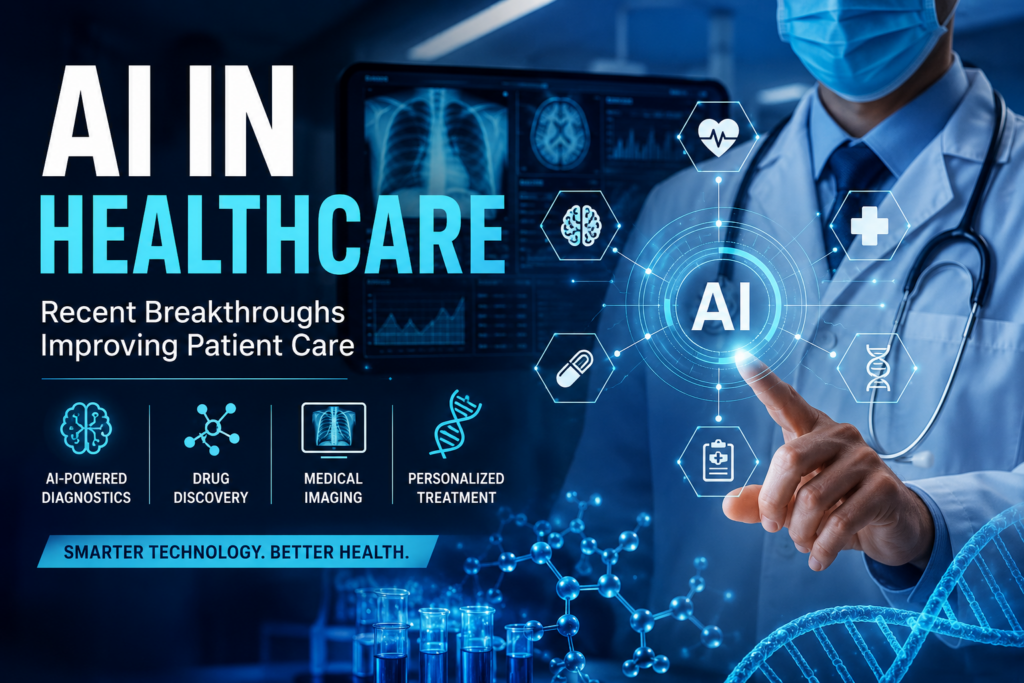


Artificial Intelligence (AI) has become one of the most transformative technologies in modern healthcare. In 2026, AI is no longer limited to research labs or experimental projects—it is actively helping physicians diagnose diseases faster, improving medical imaging, accelerating drug discovery, and delivering personalized treatment plans tailored to individual patients.
Healthcare systems worldwide face increasing challenges, including aging populations, rising medical costs, physician shortages, and the growing complexity of diseases. AI offers powerful solutions by analyzing enormous amounts of medical data in seconds, identifying patterns invisible to humans, and supporting clinicians in making better decisions.
Importantly, AI is designed to assist healthcare professionals rather than replace them. Doctors continue to provide clinical expertise, empathy, and ethical judgment, while AI helps improve efficiency, accuracy, and patient outcomes.
This article explores the latest breakthroughs in AI-powered diagnostics, drug discovery, medical imaging, personalized medicine, and the future of intelligent healthcare.
🌍 Why AI Is Transforming Healthcare
Healthcare generates massive amounts of information every day, including:
- Electronic Health Records (EHR)
- Laboratory reports
- Medical images
- Genomic sequencing
- Clinical research
- Wearable device data
- Hospital monitoring systems
Traditional analysis of these datasets is time-consuming.
AI can process millions of records almost instantly, helping healthcare providers identify diseases earlier, reduce errors, and optimize treatment decisions.
Major healthcare organizations worldwide are investing billions of dollars into AI because of its potential to improve patient care while reducing costs.
🩺 AI-Powered Diagnostics
Earlier Disease Detection
One of AI’s biggest strengths is recognizing subtle patterns that may indicate disease before symptoms become severe.
Modern AI systems assist physicians in detecting:
- Cancer
- Diabetes
- Heart disease
- Stroke
- Kidney disease
- Liver disorders
- Neurological conditions
Earlier detection often leads to better treatment outcomes and higher survival rates.
Faster Clinical Decision Support
Doctors often review hundreds of pages of patient records.
AI can summarize:
- Medical history
- Laboratory results
- Current medications
- Allergies
- Risk factors
This saves valuable time during patient consultations.
Predicting Disease Risk
AI models can estimate a patient’s likelihood of developing certain conditions by combining factors such as:
- Family history
- Lifestyle
- Blood tests
- Genetics
- Age
- Medical history
Healthcare providers can then recommend preventive measures before illness develops.
🧬 AI in Drug Discovery


Drug development has traditionally taken many years and required enormous financial investment.
AI is significantly accelerating several stages of the process.
1. Identifying Drug Targets
AI analyzes biological data to identify proteins and pathways that may be involved in diseases.
Researchers can focus on the most promising targets more quickly.
2. Screening Millions of Molecules
Instead of manually testing compounds, AI can predict which molecules are most likely to become effective medicines.
This dramatically reduces laboratory workload.
3. Predicting Drug Safety
AI helps estimate:
- Potential side effects
- Toxicity
- Drug interactions
- Effectiveness
These predictions can improve the efficiency of early-stage research, though clinical testing remains essential.
4. Supporting Clinical Trials
AI helps researchers:
- Identify suitable participants
- Monitor patient safety
- Analyze trial data
- Detect trends more rapidly
This can shorten timelines while maintaining scientific rigor.
🖥️ AI in Medical Imaging
Medical imaging is one of the most successful applications of AI.
AI supports radiologists by analyzing:
- X-rays
- CT scans
- MRI scans
- Ultrasound
- Mammograms
- Retinal images
Cancer Detection
AI can highlight suspicious areas that may require closer examination.
Applications include:
- Breast cancer
- Lung cancer
- Skin cancer
- Brain tumors
- Prostate cancer
These systems serve as decision-support tools and are typically reviewed by qualified clinicians.
Stroke Detection
Every minute matters during a stroke.
AI can rapidly identify signs of stroke from brain scans, helping prioritize urgent treatment.
Eye Disease Detection
AI assists ophthalmologists by detecting:
- Diabetic retinopathy
- Glaucoma
- Macular degeneration
Screening programs using AI may improve access to eye care in underserved regions.
Fracture Detection
Emergency departments increasingly use AI to flag possible fractures on X-rays for radiologist review, helping reduce missed injuries.
🧬 Personalized Medicine
Traditional medicine often follows standardized treatment guidelines.
AI enables more personalized care by analyzing:
- DNA
- Lifestyle
- Medical history
- Environmental factors
- Biomarkers
- Previous treatment responses
Customized Treatments
Instead of prescribing the same therapy for everyone, AI helps clinicians choose treatments more likely to benefit an individual patient.
Precision Oncology
Cancer treatment increasingly depends on the genetic characteristics of tumors.
AI helps analyze genomic information and identify therapies that may be appropriate based on a patient’s specific cancer profile.
Medication Optimization
AI can assist clinicians in selecting medications while considering:
- Age
- Weight
- Kidney function
- Liver function
- Existing prescriptions
- Allergies
This may reduce the risk of adverse drug interactions.
⌚ AI and Wearable Health Devices
Millions of people now use wearable technology.
Examples include:
- Smartwatches
- Fitness trackers
- Continuous glucose monitors
- Smart rings
These devices can monitor:
- Heart rate
- Blood oxygen
- Sleep
- Physical activity
- Blood glucose (for compatible systems)
AI analyzes these data streams to detect trends and alert users to changes that may warrant medical attention.
🤖 AI Virtual Health Assistants
Healthcare organizations increasingly use AI assistants to:
- Schedule appointments
- Answer common patient questions
- Provide medication reminders
- Assist with symptom triage
- Support chronic disease management
These tools can improve access to information while directing patients to human professionals when needed.
🏥 AI in Hospitals
Hospitals are applying AI beyond clinical diagnosis.
Examples include:
Resource Management
AI helps optimize:
- Bed allocation
- Staffing
- Equipment utilization
- Emergency department workflows
Predictive Monitoring
AI systems monitor hospitalized patients and may identify early warning signs of deterioration, enabling quicker intervention.
Administrative Automation
AI reduces repetitive tasks such as:
- Medical documentation
- Coding support
- Appointment management
- Insurance processing
This allows clinicians to spend more time with patients.
❤️ Benefits for Patients
AI contributes to patient care by supporting:
- Earlier disease detection
- Faster diagnoses
- More personalized treatment
- Better monitoring
- Reduced administrative delays
- Improved access to healthcare services
- Enhanced decision support for clinicians
⚠️ Challenges and Ethical Considerations
Despite rapid progress, AI in healthcare also presents important challenges.
Data Privacy
Medical information is highly sensitive.
Healthcare providers must protect patient data through strong cybersecurity and compliance with privacy regulations.
Bias in AI Models
If AI systems are trained on datasets that are not representative of diverse populations, performance may vary across different patient groups.
Continuous evaluation and improvement are essential.
Clinical Oversight
AI recommendations should complement—not replace—clinical expertise.
Healthcare professionals remain responsible for diagnosis, treatment decisions, and patient communication.
Regulation
Many AI-based medical devices require regulatory review before clinical use. Ongoing monitoring helps ensure safety and effectiveness as systems evolve.
🚀 Emerging Trends
Healthcare AI continues to advance in areas such as:
- Multimodal AI combining medical images, clinical notes, and laboratory data
- AI-assisted robotic surgery
- Digital twins for treatment simulation
- AI support for rare disease diagnosis
- Federated learning that helps improve AI while protecting patient privacy
- Generative AI for clinical documentation and patient education
🌟 The Future of AI in Healthcare
Over the next decade, AI is expected to become even more integrated into routine healthcare. Rather than replacing physicians, it will increasingly serve as a trusted assistant—helping interpret complex data, reducing administrative burden, and supporting more precise, timely care.
As healthcare systems adopt AI responsibly, the greatest benefits are likely to come from the collaboration between intelligent technology and skilled medical professionals. Success will depend on maintaining high standards for safety, privacy, transparency, and human oversight while using AI to improve outcomes for patients around the world.
📌 Conclusion
Artificial Intelligence is reshaping healthcare by enhancing diagnostics, accelerating drug discovery, improving medical imaging, enabling personalized medicine, and streamlining hospital operations. These breakthroughs have the potential to improve efficiency and patient outcomes, but AI works best as a support tool alongside experienced healthcare professionals. With continued advances and responsible implementation, AI is poised to become an essential part of modern medicine, helping deliver faster, smarter, and more personalized care.
🔖 SEO Title
AI in Healthcare: Recent Breakthroughs Improving Patient Care in 2026
📝 Meta Description
Discover how AI is revolutionizing healthcare through advanced diagnostics, medical imaging, drug discovery, personalized medicine, and smarter hospital systems in 2026.
🏷️ Tags
AI in Healthcare, Artificial Intelligence, Medical AI, Healthcare Technology, AI Diagnostics, Drug Discovery, Medical Imaging, Personalized Medicine, Digital Health, AI in Medicine, Healthcare Innovation, Machine Learning, Future of Healthcare, Medical Technology, Health Tech, AI Trends 2026