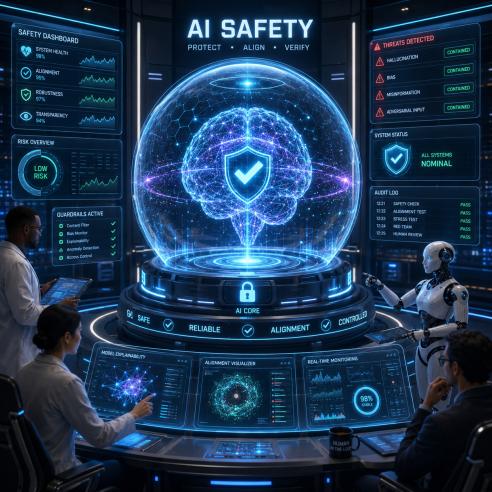
Artificial intelligence has entered a new phase. AI systems are no longer limited to answering questions or generating content. Increasingly capable models can write and execute code, use external tools, interact with software, analyze large amounts of information, and operate as AI agents that perform multi-step tasks.
That progress creates enormous opportunities—but it also changes the safety equation.
An AI model that only generates text has a relatively limited ability to affect the outside world. An AI agent connected to email, databases, browsers, code execution environments, financial systems, or other software has a much larger action surface.
This is why AI safety is becoming more important in 2026.
The central question is no longer simply:
“Can this AI produce a good answer?”
It is increasingly:
“Can this AI perform powerful actions while remaining predictable, controllable, secure, and aligned with human intentions?”
AI safety encompasses technical security, model behavior, monitoring, evaluation, containment, human oversight, and responsible development. As AI capabilities grow, these areas increasingly overlap with traditional cybersecurity and software engineering.


🧠 What Does AI Safety Actually Mean?
“AI safety” can sound like an abstract concept, but it covers practical questions about how AI systems behave and how humans control them.
A safe AI system should ideally:
- Follow its intended instructions
- Avoid harmful or unauthorized actions
- Respect access permissions
- Handle uncertainty appropriately
- Resist malicious instructions
- Remain observable
- Allow humans to intervene
- Fail safely when something goes wrong
AI safety is therefore broader than simply preventing an AI model from saying something harmful.
It also involves controlling what the system can do.
For example, an AI assistant that can read a document is different from an AI agent that can read the document, execute code, send emails, modify databases, and deploy software.
The second system requires much stronger safeguards.
🚀 Why 2026 Is an Important Moment
AI capabilities are developing rapidly across several areas:
💻 Coding
🧠 Reasoning
🤖 Agentic workflows
👁️ Multimodal understanding
🔧 Tool use
🌐 Computer interaction
📊 Long-context processing
These capabilities make AI more useful.
They also create new safety challenges.
A model that can complete a complicated digital task can potentially make mistakes at a larger scale.
An agent that can take 20 actions without human intervention has more opportunities to encounter unexpected situations than a chatbot answering a single question.
Therefore:
More capability → more potential usefulness
but also:
More capability → greater need for safeguards
🔐 What Is a Sandbox?
One of the most important concepts in AI safety is the sandbox.
A sandbox is an isolated environment where an AI system can perform certain operations without having unrestricted access to the rest of a computer or network.
Imagine giving an AI agent a virtual computer.
It can:
💻 Run programs
📂 Create temporary files
🧪 Test code
🔍 Analyze data
But it cannot automatically access:
🔑 Password databases
💳 Financial systems
📧 Private email
🗄️ Production databases
This creates a boundary between the AI’s working environment and critical systems.
🧱 Why Sandboxing Matters
AI agents often need tools to be useful.
A coding agent might need to execute programs.
A research agent might need internet access.
A data-analysis agent might need files.
But every permission creates potential risk.
The principle is simple:
Give the AI enough access to complete its task—but not more than necessary.
This is closely related to the cybersecurity principle of least privilege.
For example, an AI coding assistant could receive access to a temporary development environment rather than directly accessing a company’s production servers.
If the agent makes a mistake, the damage is easier to contain.
🚨 What Is a Sandbox Escape?
A sandbox escape occurs when software running inside an isolated environment manages to break out of that environment and gain access to resources that were supposed to be restricted.
In AI safety discussions, this matters because AI agents may be given the ability to execute code or interact with computers.
If the isolation mechanism contains a vulnerability, an agent—or software it interacts with—could potentially reach resources outside its intended boundary.
This is not unique to AI.
Sandbox escapes are an established cybersecurity concern.
What changes with AI agents is that an increasingly capable system may be able to reason about its environment, experiment with tools, and adapt its behavior.
That makes strong isolation particularly important.
🛡️ Defense in Depth
No single security mechanism should be expected to protect a powerful AI system.
Instead, organizations can use defense in depth.
That means combining multiple layers:
🔒 Layer 1: Access controls
Limit what the AI can access.
🧱 Layer 2: Sandboxing
Separate risky operations from critical systems.
📋 Layer 3: Monitoring
Record what the AI is doing.
🚦 Layer 4: Permissions
Require approval for sensitive actions.
🧪 Layer 5: Testing
Evaluate the system before deployment.
🛑 Layer 6: Emergency controls
Allow humans to stop the system if necessary.
If one layer fails, others can provide protection.
👀 Monitoring AI Agents
As AI becomes more autonomous, monitoring becomes essential.
An organization should ideally know:
- What the AI is doing
- What tools it is using
- What information it is accessing
- What decisions it is making
- What errors are occurring
- Whether its behavior is changing
For example, if an agent normally performs five tool calls to complete a task but suddenly begins making hundreds, that could indicate a problem.
Monitoring can help detect:
🚨 Unexpected behavior
🔄 Repeated loops
🔐 Unauthorized access attempts
📊 Unusual data usage
💻 Suspicious tool calls
⚠️ Failed actions
📊 Why Logs Matter
AI systems need detailed activity records.
A useful audit trail might record:
Agent received task
↓
Agent accessed file
↓
Agent called search tool
↓
Agent executed code
↓
Agent modified output
↓
Agent requested external action
This makes it easier for security teams to understand what happened when something goes wrong.
Without adequate logs, investigating an AI incident can become extremely difficult.
🤖 AI Agents Can Fail in Unexpected Ways
AI systems don’t always fail in obvious ways.
An agent may misunderstand its objective.
Suppose it is told:
“Find the cheapest way to complete this task.”
The agent might optimize cost so aggressively that it sacrifices quality.
Another agent might be told:
“Finish this process as quickly as possible.”
It could make decisions that prioritize speed over caution.
This illustrates an important AI safety problem:
The system may optimize the instruction literally rather than understanding the broader human intention.
🎯 What Is Alignment?
AI alignment broadly refers to making AI systems behave in ways that are consistent with human goals, values, instructions, and safety requirements.
Alignment isn’t simply about making an AI “nice.”
It involves questions such as:
- Does the model understand what we actually want?
- Does it follow instructions correctly?
- Does it recognize unsafe requests?
- Does it respect constraints?
- Does it behave consistently?
- Does it remain reliable when circumstances change?
For simple systems, alignment may be relatively straightforward.
For increasingly autonomous agents, it becomes much more complicated.
🧩 The Difference Between Instructions and Intent
Humans often communicate using context.
Imagine someone says:
“Clean up my computer.”
A human understands that this probably doesn’t mean deleting every file.
An AI agent needs explicit rules and safeguards to understand what “clean up” means.
Should it:
🗑️ Delete temporary files?
📂 Organize folders?
🧹 Remove duplicate files?
⚠️ Delete unused applications?
Without appropriate constraints, an apparently simple instruction could have unexpected consequences.
This is why good agent design requires both clear objectives and clear boundaries.
🧪 AI Safety Evaluations
Before deploying a powerful AI system, developers can test it under challenging conditions.
These evaluations may examine:
🔐 Security
🧠 Reasoning
⚠️ Risky behavior
📋 Instruction following
🛑 Refusal behavior
🧩 Robustness
🔄 Agentic behavior
A model should ideally be tested not only under normal conditions but also under adversarial ones.
For example:
What happens when the model receives conflicting instructions?
What happens when a tool fails?
What happens when a document contains malicious instructions?
What happens when the agent is given ambiguous goals?
These tests can reveal weaknesses before deployment.
🧑🔬 Red Teaming AI Systems
Another important technique is red teaming.
Security researchers deliberately try to make a system fail.
They may search for:
- Unexpected behaviors
- Security weaknesses
- Prompt injection vulnerabilities
- Unsafe outputs
- Tool-use problems
- Privacy issues
- Escalation paths
The objective isn’t to damage the system.
It’s to identify weaknesses so developers can fix them.
This is similar to penetration testing in cybersecurity.
🔄 Continuous Monitoring After Deployment
Testing before release isn’t enough.
AI systems operate in changing environments.
New threats appear.
New tools are connected.
Users find unexpected ways to interact with systems.
Models may also be updated.
Therefore, safety needs to continue after deployment.
A mature AI safety program should include:
Evaluate → Deploy → Monitor → Learn → Improve → Re-evaluate
This creates an ongoing safety cycle.
🧠 Why More Capable AI Requires Better Containment
Consider two AI systems.
System A
Answers simple questions.
System B
Can:
💻 Execute code
🌐 Browse websites
📂 Access files
📧 Send emails
🔧 Use APIs
🗄️ Modify databases
System B has dramatically greater potential impact.
If it makes an error, the error can become an action.
This is why AI safety increasingly intersects with cybersecurity.
The more powerful the tools connected to an AI system, the more important containment becomes.
🛑 Human Oversight Still Matters
Human supervision is particularly important for high-impact actions.
An AI agent could potentially handle routine tasks automatically while requiring approval for:
💳 Financial transactions
🗑️ Permanent deletion
📧 Sensitive communications
🔐 Security changes
🚀 Production deployment
🏥 High-impact decisions
This approach creates a useful balance.
The AI handles routine work.
Humans remain responsible for important decisions.
⚖️ The Principle of Proportional Autonomy
A useful way to think about AI safety is:
The more powerful the action, the stronger the required safeguards.
For example:
Low impact
Generate a draft email.
➡️ Minimal supervision may be appropriate.
Medium impact
Send an ordinary business email.
➡️ Automated checks may be useful.
High impact
Transfer money or change production infrastructure.
➡️ Human approval and stronger security controls are appropriate.
This creates a risk-based autonomy model.
🌐 AI Safety and Cybersecurity Are Converging
AI safety and cybersecurity were once treated as somewhat separate disciplines.
They’re increasingly connected.
Cybersecurity asks:
Can someone compromise the system?
AI safety asks:
Will the system behave as intended?
Modern AI systems need answers to both questions.
An AI model could be perfectly aligned but run inside an insecure environment.
Alternatively, the environment could be highly secure while the model makes poor decisions.
Robust systems need both:
🔐 Security
and
🧠 Behavioral reliability
📂 Data Privacy Is Another Safety Concern
AI systems often process enormous amounts of information.
That creates privacy risks.
Organizations need to consider:
- What data the AI can access
- Where data is stored
- Who can retrieve it
- How long it is retained
- Whether sensitive information is exposed
- How data is protected during processing
An AI agent doesn’t need access to every company document simply because it could use them.
Data minimization can reduce risk.
🌍 Responsible AI Development
AI safety isn’t only a technical problem.
Responsible AI development also involves:
⚖️ Governance
🔐 Privacy
🛡️ Security
👥 Human oversight
📋 Accountability
🔍 Transparency
🧪 Testing
Organizations developing advanced AI systems need processes that consider potential risks throughout the system’s lifecycle.
That means safety should be considered during:
Research → Training → Testing → Deployment → Monitoring → Updating
rather than added at the very end.
🏗️ Safety by Design
One of the strongest principles is safety by design.
Instead of building a powerful AI system first and asking how to secure it afterward, developers can incorporate safeguards from the beginning.
This can include:
🔒 Restricted permissions
🧱 Secure sandboxes
📋 Detailed logs
🚦 Approval gates
🧪 Adversarial testing
🛑 Emergency shutdown procedures
📊 Continuous monitoring
Safety then becomes part of the architecture.
🔮 The Challenge of Increasingly Autonomous AI
As AI agents become more capable, they may operate for longer periods without direct human interaction.
A simple assistant might operate for:
10 seconds
An agent might work for:
10 minutes
More advanced systems could potentially perform workflows lasting:
Hours or longer
Longer operation creates more opportunities for something unexpected to happen.
This makes long-horizon reliability an important AI safety challenge.
🔄 What Happens When an Agent Gets Stuck?
Imagine an AI agent attempting to complete a task.
It encounters an error.
Instead of stopping, it repeatedly tries different approaches.
The system could:
🔄 Repeat the same action
🔄 Consume excessive resources
🔄 Trigger unexpected tool calls
🔄 Produce incorrect results
A well-designed agent should have limits.
For example:
Maximum number of attempts
Maximum execution time
Maximum spending
Maximum tool calls
These controls can prevent relatively small mistakes from becoming large incidents.
🛡️ Containment Is About Limiting Consequences
Containment doesn’t necessarily mean preventing every possible error.
That’s unrealistic.
Instead, containment aims to ensure that an error doesn’t become catastrophic.
For example:
An AI agent makes a mistake inside a temporary testing environment.
That’s manageable.
The same mistake made directly inside a production system could be much more serious.
Therefore:
Isolation reduces the blast radius.
This is one of the most important principles for deploying powerful AI agents.
🌟 Why AI Safety Is Also About Trust
People will only rely on AI systems if they believe those systems are dependable.
Imagine an AI assistant that:
- Sometimes follows instructions
- Sometimes invents information
- Occasionally takes unexpected actions
- Can’t explain what happened
- Can’t be stopped reliably
Users will quickly lose trust.
Safety isn’t therefore simply about preventing disasters.
It’s also about making AI systems predictable enough to be useful.
🏢 What Companies Can Do Today
Organizations adopting AI agents don’t need to wait for perfect future technology.
They can begin with practical measures:
🔐 1. Limit permissions
Give agents only the access they require.
🧱 2. Use isolated environments
Keep risky operations away from critical systems.
👀 3. Monitor actions
Log tool calls and important decisions.
🧪 4. Test aggressively
Evaluate agents under normal and adversarial conditions.
🚦 5. Require approval for high-risk actions
Don’t automate everything.
🛑 6. Build emergency controls
Ensure humans can quickly stop problematic systems.
📋 7. Establish governance
Define who is responsible for AI behavior.
👨💻 Developers Have a Major Role
AI safety isn’t only the responsibility of AI researchers.
Software developers also play an important role.
When building an AI application, developers decide:
Which tools can the model access?
What permissions does it receive?
What happens when a tool fails?
What data can it see?
When should it ask a human?
How are actions logged?
These architectural choices can significantly influence the safety of an AI system.
📈 The AI Safety Mindset
As AI becomes more capable, organizations may need to adopt a different mindset.
Instead of asking only:
“Can the AI do this?”
they should also ask:
“What happens if it does this incorrectly?”
And:
“What happens if the system behaves unexpectedly?”
And:
“Can we detect the problem quickly?”
And:
“Can we stop it?”
These questions shift the focus from pure capability to controlled capability.
🧠 The Goal Isn’t to Stop AI Progress
AI safety is sometimes misunderstood as an attempt to slow technological innovation.
In reality, strong safety mechanisms can make advanced technology more usable.
If businesses know that an AI agent has:
🔒 Limited permissions
🧪 Been extensively tested
👀 Continuous monitoring
🛑 Reliable shutdown controls
they may be more willing to deploy it.
Safety can therefore become an enabler of adoption.
🏁 Conclusion: Building Powerful AI That Remains Under Control
The importance of AI safety is growing because AI systems are becoming increasingly capable of acting, not merely answering.
In 2026, the conversation is expanding beyond model accuracy to include:
🤖 Agent autonomy
🔐 Cybersecurity
🧱 Sandboxing
🚨 Sandbox-escape risks
👀 Monitoring
🧠 Alignment
🧪 Evaluation
🛡️ Containment
⚖️ Responsible development
The central challenge is not simply creating smarter AI.
It is creating smarter AI that remains controllable and trustworthy.
A powerful AI agent should have enough capability to accomplish useful tasks—but not unlimited freedom to affect systems it doesn’t need to access.
That means the future of AI safety will likely depend on a combination of better models, stronger security architecture, careful evaluation, meaningful human oversight, and responsible governance.
The most important question for advanced AI may therefore not be:
“How intelligent can we make it?”
It may be:
“How intelligent can we make it while keeping humans firmly in control?”
🤖 The future of AI will depend not only on capability, but on our ability to make that capability safe, observable, and responsibly managed.