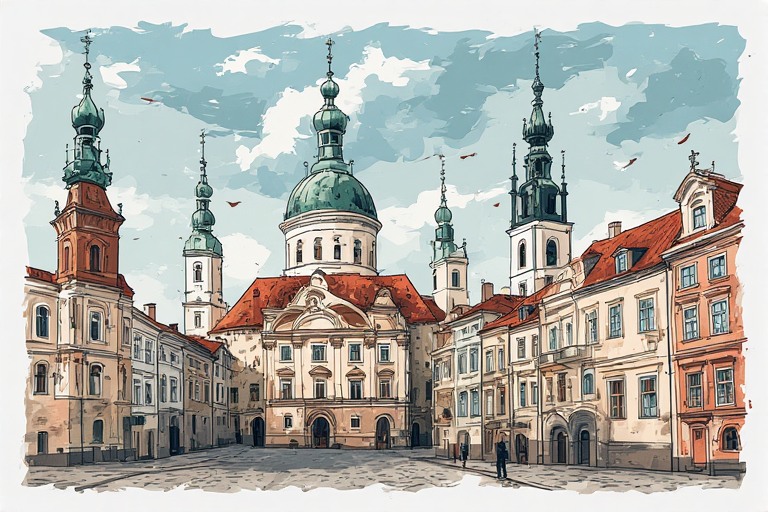
Poland’s architectural landscape is a layered story of resilience, cultural exchange, and artistic evolution. From towering medieval cathedrals to ornate Baroque palaces and sleek modernist buildings, the country offers a visual timeline of European history. Each era—Gothic, Baroque, and Modern—has left a distinct imprint on Polish cities and towns, making architecture one of the most powerful ways to understand Poland’s identity.
Gothic Architecture: Medieval Foundations of Poland
Gothic architecture in Poland began flourishing in the 13th century, influenced by Western European styles but adapted to local materials and traditions. This era is best known for its brick Gothic structures, as Poland had limited access to natural stone compared to Western Europe.
One of the finest examples is the Royal Castle in Kraków, a historic residence that reflects early Gothic influences blended with later renovations. Similarly, St. Mary’s Basilica in Kraków stands as a masterpiece of Gothic design, famous for its towering spires, stained glass windows, and intricate wooden altarpiece carved by Veit Stoss.
Gothic architecture in Poland is characterized by:
- Pointed arches and ribbed vaults
- Tall, narrow windows with stained glass
- Brick construction (especially in northern regions)
- Emphasis on verticality and light
Cities like Gdańsk and Toruń also preserve impressive Gothic town halls and churches, reflecting their importance as medieval trade centers in the Hanseatic League.
Baroque Architecture: Grandeur and Royal Influence
The Baroque period arrived in Poland in the late 16th century and reached its peak in the 17th and 18th centuries. This style reflected the power of the Polish-Lithuanian Commonwealth and the influence of Catholic Counter-Reformation aesthetics.
Baroque architecture in Poland is dramatic, emotional, and highly decorative. It often features curved forms, elaborate ornamentation, and grand spatial designs meant to inspire awe.
A key example is the Wilanów Palace in Warsaw, often called the “Polish Versailles.” This royal residence combines Italian Baroque influences with Polish architectural traditions. Inside, richly decorated interiors and expansive gardens highlight the opulence of the era.
Other notable Baroque landmarks include:
- Jesuit churches in Poznań and Warsaw
- Krasiński Palace in Warsaw
- Church of St. Anne in Kraków
Baroque architecture in Poland symbolizes:
- Religious devotion and political power
- Ornate façades and sculptural decoration
- Dynamic spatial compositions
- Integration of architecture with gardens and landscapes
Modern Architecture: Rebuilding Identity
Poland’s modern architecture reflects both the challenges of the 20th century and the country’s rapid transformation after World War II and the fall of communism in 1989. Much of Poland was destroyed during the war, especially in cities like Warsaw, which had to be rebuilt almost from scratch.
Post-war architecture initially followed socialist realism, emphasizing monumental, state-driven designs. However, contemporary Poland now showcases a diverse range of modern and postmodern styles.
A striking example is the Warsaw Uprising Museum in Warsaw, which blends industrial aesthetics with emotional storytelling. Another landmark is the Warsaw Spire, a glass-and-steel skyscraper symbolizing Poland’s integration into the global economy.
Modern Polish architecture is defined by:
- Minimalist and functional design
- Glass, steel, and concrete materials
- Sustainable and energy-efficient construction
- Blending historic preservation with innovation
Cities like Warsaw, Wrocław, and Łódź are especially known for their evolving skylines, where restored historic buildings stand alongside cutting-edge developments.
A Living Architectural Timeline
What makes Poland unique is the way these architectural styles coexist. In many cities, Gothic churches stand just blocks away from Baroque palaces and modern skyscrapers. This contrast reflects Poland’s complex history of invasions, partitions, independence, and renewal.
Walking through Poland today is like moving through centuries of European architectural evolution in a single journey.