Artificial Intelligence (AI) has transformed from a theoretical idea into one of the most influential technologies of the modern world. From early philosophical concepts to today’s advanced machine learning systems, AI’s journey is both fascinating and groundbreaking.
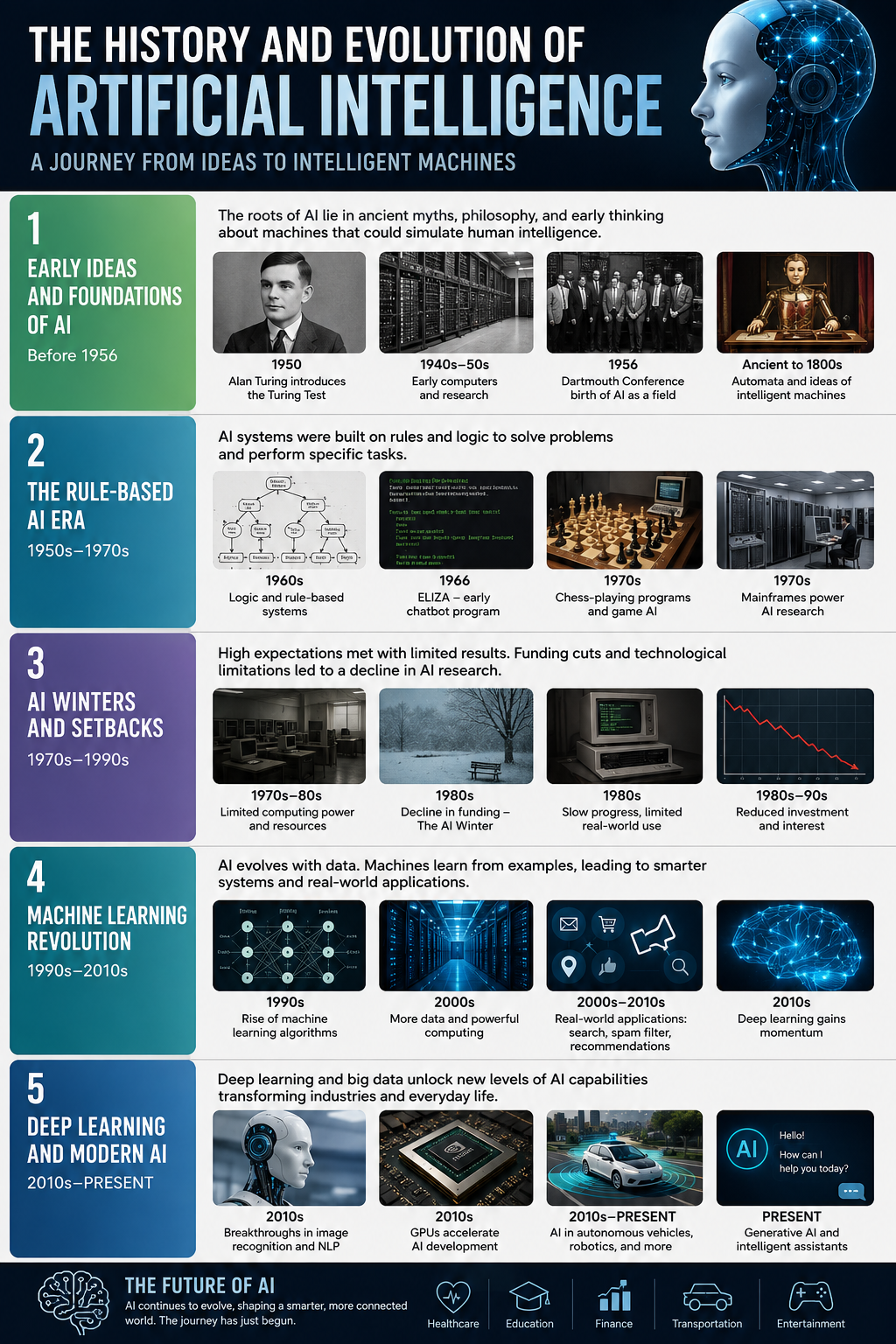
1. Early Ideas and Foundations of AI
The concept of artificial beings with intelligence dates back to ancient myths and philosophical thinking. However, AI as a scientific field began in the mid-20th century.


6
In 1950, mathematician Alan Turing introduced the famous “Turing Test,” questioning whether machines can think. This laid the intellectual foundation for AI. In 1956, the Dartmouth Conference officially marked the birth of AI as a field, where researchers believed machines could simulate human intelligence.
2. The Rule-Based AI Era (1950s–1970s)
Early AI systems were built on rigid rules and logic. These systems could solve mathematical problems and play games but lacked flexibility.


7
During this period, AI researchers focused on symbolic reasoning. Programs like ELIZA (an early chatbot) and chess-playing machines showed promise, but limited computing power restricted progress. Expectations were high, but real-world applications were limited.
3. AI Winters and Setbacks (1970s–1990s)
Despite early excitement, AI research faced major setbacks due to funding cuts and technological limitations—this period is known as the “AI Winter.”


7
Computers were not powerful enough, and rule-based systems could not handle complex real-world problems. As a result, interest and investment in AI decreased significantly for years.
4. Machine Learning Revolution (1990s–2010s)
AI made a strong comeback with the rise of machine learning, where systems learn patterns from data instead of relying on hard-coded rules.


7
This era saw breakthroughs in speech recognition, recommendation systems, and search engines. Algorithms became smarter as they were trained on large datasets, marking a shift from “rule-based AI” to “data-driven AI.”
5. Deep Learning and Modern AI (2010s–Present)
Deep learning, powered by neural networks and GPUs, revolutionized AI capabilities. It enabled breakthroughs in image recognition, natural language processing, and generative AI.


6
Today, AI systems like virtual assistants, autonomous vehicles, and generative models (like chatbots and image generators) are widely used across industries—from healthcare and education to entertainment and finance.
Conclusion
The evolution of Artificial Intelligence shows a remarkable journey of human innovation, setbacks, and breakthroughs. What started as a philosophical question has become a powerful technology shaping our future. As AI continues to evolve, it will likely become even more integrated into daily life, raising both exciting possibilities and important ethical questions.