How AI-Powered Workers Are Changing Customer Service, Research, Coding, Marketing, and Business Operations


Introduction: The Rise of the Digital Workforce 🌐
For more than a century, companies have depended on human employees to manage operations, solve problems, communicate with customers, and create new ideas. But a new type of workforce is emerging: AI employees.
Unlike traditional software tools that only perform specific commands, AI-powered workers can analyze information, make decisions, complete tasks, communicate with people, and continuously improve through learning.
These virtual workers are not physical robots sitting in offices. They are intelligent AI systems capable of performing professional tasks across industries.
An AI employee may:
- Answer thousands of customer questions
- Analyze market trends
- Write and debug software code
- Create marketing campaigns
- Manage business workflows
- Conduct research
- Assist human teams with decision-making
The future workplace may not be humans versus machines. Instead, it may become a collaboration between human employees and intelligent AI teammates.
1. What Are AI Employees? 🤖
AI employees are advanced AI systems designed to perform workplace responsibilities traditionally handled by humans.
They are powered by technologies such as:
- Large language models
- Machine learning
- AI agents
- Automation systems
- Natural language processing
- Data analysis tools
Unlike basic automation, which follows fixed rules, AI employees can adapt to changing situations.
For example:
A traditional chatbot might answer:
“Your order is being processed.”
An AI customer service employee could:
- Understand the customer’s frustration
- Review order history
- Suggest solutions
- Process refunds
- Escalate complex issues
The difference is intelligence and autonomy.
2. AI Customer Service Employees: The First Digital Workforce 🌍📞


Customer service is one of the first areas where AI employees are becoming widely adopted.
Companies receive millions of customer requests every day. Human teams often struggle with response times, repetitive questions, and increasing costs.
AI customer service workers can provide:
- 24/7 support
- Instant responses
- Multilingual communication
- Personalized recommendations
- Automatic issue resolution
Beyond Simple Chatbots
Future AI customer service employees will do more than answer questions.
They may:
- Analyze customer emotions
- Predict customer needs
- Recommend products
- Resolve complaints
- Manage entire customer journeys
For companies, this means faster service and improved customer experiences.
For customers, it means receiving immediate assistance anytime.
3. AI Researchers: The New Knowledge Workers 🔎
Research is another area where AI employees could create major changes.
Businesses spend significant time collecting and analyzing information.
AI research assistants can:
- Read thousands of documents
- Summarize reports
- Analyze competitors
- Identify market trends
- Generate business insights
A human researcher may spend days reviewing information. An AI research worker can process massive amounts of data within minutes.
Business Intelligence Transformation
Companies could use AI researchers to continuously monitor:
- Industry changes
- Customer behavior
- Economic trends
- Competitor strategies
This allows organizations to make faster decisions based on real-time information.
4. AI Software Developers: The Future of Coding 💻


Software development is experiencing one of the biggest AI transformations.
AI coding employees can assist with:
- Writing code
- Finding bugs
- Testing applications
- Creating documentation
- Improving software performance
Future AI developers may handle entire development workflows.
For example, a company could provide an AI system with a simple instruction:
“Create a mobile application for online appointment booking.”
The AI could:
- Design the application structure
- Generate code
- Test features
- Identify errors
- Suggest improvements
Human developers would focus more on architecture, creativity, and strategic decisions.
5. AI Marketing Employees: Automated Creativity and Strategy 📢
Marketing requires creativity, analysis, and understanding customer behavior.
AI marketing employees can support:
- Content creation
- Social media management
- Customer analysis
- Advertising optimization
- Email campaigns
Personalized Marketing at Scale
Traditional marketing often creates campaigns for large audiences.
AI can create personalized experiences for individual customers.
AI systems can analyze:
- Customer interests
- Buying patterns
- Online behavior
- Market trends
Then they can generate targeted campaigns automatically.
This could transform how businesses attract and retain customers.
6. AI Business Operations Managers ⚙️
One of the most interesting developments is AI systems managing complex workflows.
An AI operations employee could help with:
- Scheduling
- Inventory management
- Financial analysis
- Supply chain monitoring
- Internal communication
For example, an AI operations manager could detect:
“Product demand is increasing in one region. Inventory levels may become insufficient within two weeks.”
It could then recommend solutions automatically.
AI employees may become valuable decision-support partners for executives.
7. The Rise of AI Agents: Autonomous Digital Workers 🚀
The foundation of AI employees is the rise of AI agents.
Unlike traditional AI tools that wait for instructions, AI agents can:
- Set goals
- Plan tasks
- Use multiple tools
- Make decisions
- Complete workflows independently
A future AI agent could receive a business goal:
“Increase customer engagement this month.”
It might:
- Analyze customer data
- Create marketing ideas
- Launch campaigns
- Measure results
- Suggest improvements
This represents a major shift from AI assistance to AI collaboration.
8. How Companies Will Work With AI Employees 🏢
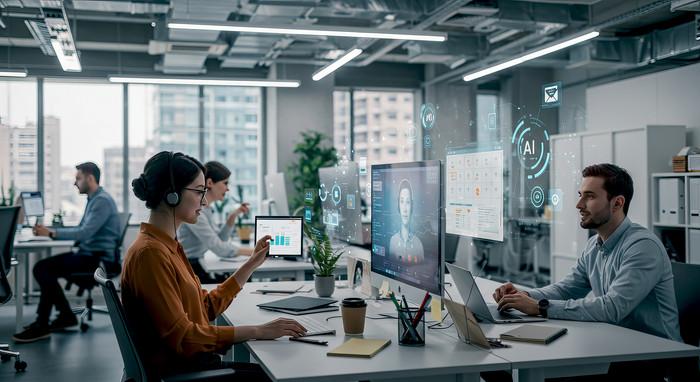
The future workplace may include teams made up of both humans and AI workers.
A company department might look like:
Human Manager
Provides strategy and leadership.
AI Research Employee
Collects and analyzes information.
AI Marketing Employee
Creates campaigns and content.
AI Customer Support Employee
Handles customer interactions.
Human Specialists
Focus on creativity, relationships, and complex decisions.
This hybrid workforce could increase productivity dramatically.
9. Benefits of AI Employees 🌟
Increased Productivity
AI workers can operate continuously without fatigue.
They can handle repetitive tasks while humans focus on higher-value activities.
Faster Decision-Making
AI can analyze information quickly and provide insights.
Lower Operational Costs
Businesses can automate many routine processes.
Global Availability
AI employees can support customers and teams across different languages and time zones.
Improved Innovation
By handling repetitive work, AI allows humans to focus on creativity and strategy.
10. Challenges and Concerns About AI Workers ⚠️
The rise of AI employees also creates important questions.
Job Transformation
Some tasks currently performed by humans may become automated.
However, many experts believe AI will also create new roles focused on managing, designing, and improving AI systems.
Trust and Accountability
Companies must decide:
- Who is responsible for AI decisions?
- How should AI mistakes be handled?
- How much independence should AI have?
Security Risks
AI employees may access sensitive company information, creating cybersecurity concerns.
Human Skills Remain Important
Creativity, leadership, empathy, and critical thinking will remain valuable human abilities.
11. The Future of Work: Humans + AI 🤝
The future workplace will likely not be completely automated.
Instead, AI employees may become digital colleagues working alongside humans.
Humans will provide:
- Vision
- Creativity
- Emotional intelligence
- Ethical judgment
- Leadership
AI will provide:
- Speed
- Data analysis
- Automation
- Continuous assistance
The strongest companies may be those that learn how to combine human talent with artificial intelligence.
Conclusion: The Virtual Workforce Era Has Begun 🚀
AI employees represent one of the biggest changes in the future of business.
From customer service and research to coding, marketing, and operations, virtual workers are becoming capable of performing increasingly complex tasks.
The question is no longer whether AI will enter the workplace—it already has.
The bigger question is how businesses and employees will adapt to this new era.
The companies of the future may not be those with the most employees, but those that build the most effective collaboration between humans and intelligent digital workers.
AI employees are coming, and they may become the newest members of the global workforce. 🤖🌎