Exploring Adaptive Learning, AI Tutors, Automated Feedback, Accessibility, and the Future of Personalized Education
📚 Introduction
Education has always aimed to meet the unique needs of every learner. However, traditional classrooms often struggle to accommodate different learning speeds, interests, and abilities. While some students require additional support, others may need more advanced challenges to stay engaged. With one teacher managing dozens of students, providing individualized instruction can be difficult.
Artificial Intelligence (AI) is beginning to change this reality. Rather than replacing teachers, AI is becoming a powerful educational assistant that helps personalize learning experiences for millions of students worldwide. From intelligent tutoring systems to adaptive learning platforms, AI is transforming education into something more flexible, inclusive, and data-driven.
The question is no longer whether AI belongs in education, but rather how it can create better learning experiences while preserving the essential role of human educators.
🧠 What Is Personalized Learning?
Personalized learning is an educational approach that adapts lessons, activities, and assessments to each student’s:
- 🎯 Learning pace
- 📖 Knowledge level
- 💡 Learning style
- 🎮 Interests
- 📊 Performance history
- 🎓 Educational goals
Instead of every student following exactly the same path, personalized learning allows each learner to progress at the pace that suits them best.
AI makes this possible on a much larger scale than traditional methods.
🖼️ How AI Personalizes Learning


AI continuously collects learning data such as:
- Quiz scores
- Assignment completion
- Time spent on lessons
- Common mistakes
- Areas of confidence
- Preferred learning formats
Using machine learning algorithms, the system adjusts future lessons accordingly.
For example:
A student struggling with algebra receives:
- More practice problems
- Step-by-step explanations
- Interactive visual examples
- Easier questions before progressing
Meanwhile another student who masters the topic quickly receives:
- Advanced challenges
- Enrichment projects
- Higher-level exercises
This creates a learning journey unique to every student.
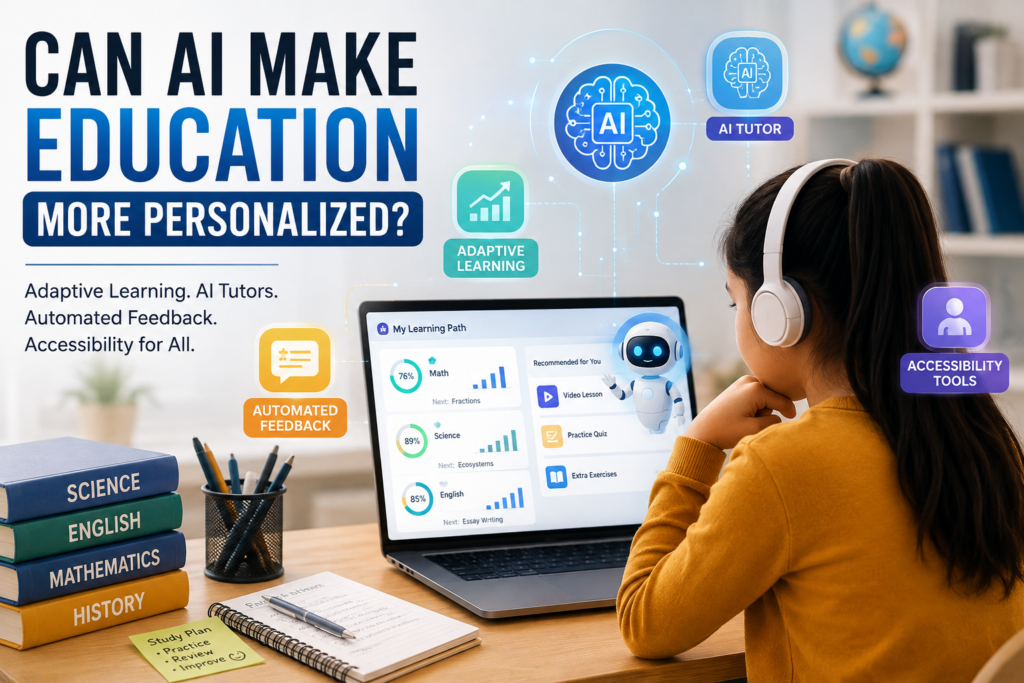
📈 Adaptive Learning Platforms
Adaptive learning platforms automatically modify educational content based on student performance.
Instead of fixed lessons, AI creates dynamic pathways.
How Adaptive Learning Works
- Student completes an assessment.
- AI analyzes strengths and weaknesses.
- Platform identifies learning gaps.
- New content is recommended.
- Difficulty adjusts automatically.
- Progress is monitored continuously.
Example Scenario
Imagine two students learning fractions.
Student A
- Understands basic concepts quickly
- Scores 95%
- Receives advanced fraction problems
Student B
- Scores 55%
- Receives additional tutorials
- Watches animations
- Completes interactive exercises
- Gets easier practice before moving forward
Both students remain challenged without becoming overwhelmed.
🤖 AI Tutors: Learning Anytime
🖼️ AI Tutoring


One of AI’s biggest contributions is the rise of intelligent tutoring systems.
Unlike traditional tutoring, AI tutors are available:
- 🌍 24/7
- 📱 On phones
- 💻 On laptops
- 🏠 From home
- ✈️ While traveling
Students can ask questions whenever they need help.
Examples include:
- Explaining difficult concepts
- Solving math problems step-by-step
- Reviewing essays
- Practicing foreign languages
- Preparing for exams
- Generating quizzes
Rather than simply providing answers, modern AI tutors increasingly guide students through the reasoning process.
✍️ Automated Feedback
One of the biggest challenges teachers face is grading large numbers of assignments.
AI can provide immediate feedback on:
- Multiple-choice quizzes
- Programming assignments
- Mathematics
- Grammar
- Vocabulary
- Reading comprehension
- Practice essays
Instant feedback helps students correct mistakes while the material is still fresh.
For example:
Instead of waiting several days for quiz results, students receive feedback immediately after submitting their work.
This encourages continuous improvement.
📊 Learning Analytics
Every interaction creates useful learning data.
AI analyzes:
- Time spent studying
- Difficult concepts
- Progress over weeks
- Attendance
- Assignment completion
- Confidence levels
- Learning trends
Teachers receive dashboards showing:
- Students at risk
- Topics needing review
- Class-wide performance
- Individual growth
This enables more targeted classroom support.
🌍 AI Improves Accessibility
🖼️ Inclusive Learning


AI has enormous potential to make education more inclusive.
Students with Visual Impairments
AI provides:
- Text-to-speech
- Audio descriptions
- Screen reading
- Voice navigation
Students with Hearing Impairments
AI supports:
- Real-time captions
- Speech transcription
- Sign-language research tools
- Subtitle generation
Students with Learning Disabilities
AI can:
- Break lessons into smaller parts
- Repeat explanations
- Offer visual learning aids
- Read text aloud
- Simplify language
Language Learners
AI translation tools assist students by:
- Translating lessons
- Explaining unfamiliar vocabulary
- Practicing pronunciation
- Supporting multilingual education
These capabilities help reduce barriers to learning.
🎮 AI Makes Learning More Engaging
AI-powered educational software often includes:
- 🏆 Badges
- 🎯 Challenges
- 🎮 Gamification
- 📈 Progress tracking
- 🌟 Rewards
- 🔥 Learning streaks
These features encourage regular practice and improve motivation.
📚 Personalized Content Recommendations
Much like streaming platforms recommend movies, AI recommends learning resources.
Suggestions may include:
- Videos
- Practice exercises
- Interactive simulations
- Articles
- Flashcards
- Revision quizzes
- Advanced topics
This helps learners focus on resources that match their current needs.
🌐 Language Learning with AI
AI has transformed language education through:
- Real-time conversation practice
- Pronunciation feedback
- Grammar correction
- Vocabulary quizzes
- Personalized study plans
- Speaking simulations
Students can practice confidently without worrying about making mistakes in front of others.
👨🏫 Supporting Teachers, Not Replacing Them
A common misconception is that AI will replace teachers.
In reality, AI handles repetitive tasks while teachers focus on human-centered aspects of education.
AI assists with:
- Attendance tracking
- Grading routine work
- Creating quizzes
- Identifying struggling students
- Organizing lesson materials
Teachers continue to provide:
- Mentorship
- Emotional support
- Classroom leadership
- Critical discussions
- Creativity
- Ethical guidance
The most effective classrooms combine AI efficiency with human expertise.
🎓 Benefits of AI-Powered Personalized Education
✅ Learning at individual pace
✅ Immediate feedback
✅ Better student engagement
✅ Personalized study paths
✅ Improved accessibility
✅ Teacher workload reduction
✅ Data-driven decision making
✅ Continuous assessment
✅ Better resource recommendations
✅ Flexible learning anytime, anywhere
⚠️ Challenges and Concerns
Despite its promise, AI in education raises important issues.
Privacy and Data Security
AI systems often rely on student data.
Schools must protect:
- Academic records
- Personal information
- Learning behaviors
- Assessment results
Strong security and transparent data practices are essential.
Digital Divide
Not every learner has access to:
- High-speed internet
- Modern devices
- Reliable electricity
Without investment in infrastructure, AI could widen educational inequalities instead of reducing them.
Bias in AI Systems
If AI models are trained on biased data, they may produce unfair recommendations or assessments.
Developers and educators should regularly evaluate systems for fairness and accuracy.
Overdependence on AI
Students who rely too heavily on AI may miss opportunities to develop:
- Critical thinking
- Problem-solving
- Independent research
- Creativity
AI should support learning—not replace active engagement.
Teacher Training
Educators need professional development to use AI tools effectively.
Training should include:
- Responsible AI use
- Interpreting learning analytics
- Protecting student privacy
- Designing AI-enhanced lessons
🚀 The Future of Personalized Education
Emerging AI capabilities may include:
- 🥽 Immersive virtual classrooms
- 🧪 AI-guided science simulations
- 🌍 Real-time multilingual instruction
- 🧠 Emotion-aware learning systems that adapt to signs of confusion or engagement
- 📚 Highly personalized curricula
- 🤝 Human-AI collaboration in lesson planning
As these technologies mature, thoughtful governance will be important to ensure they are accurate, equitable, and used in ways that benefit learners.
💡 Best Practices for Responsible AI in Education
- Keep teachers at the center of learning.
- Be transparent about when and how AI is used.
- Protect student privacy and data.
- Verify AI-generated information.
- Encourage critical thinking instead of copying AI outputs.
- Ensure AI tools are accessible and inclusive.
- Review AI systems regularly for fairness and effectiveness.
🎯 Conclusion
Artificial Intelligence has the potential to make education significantly more personalized by adapting lessons to each learner’s needs, providing instant feedback, expanding access through assistive technologies, and giving teachers valuable insights into student progress. These capabilities can improve engagement and help students learn more effectively.
However, personalization alone is not enough. Successful adoption requires careful attention to privacy, fairness, accessibility, and the continued leadership of educators. When AI is used responsibly—as a tool that complements rather than replaces teachers—it can help create learning environments where every student has a better opportunity to succeed.