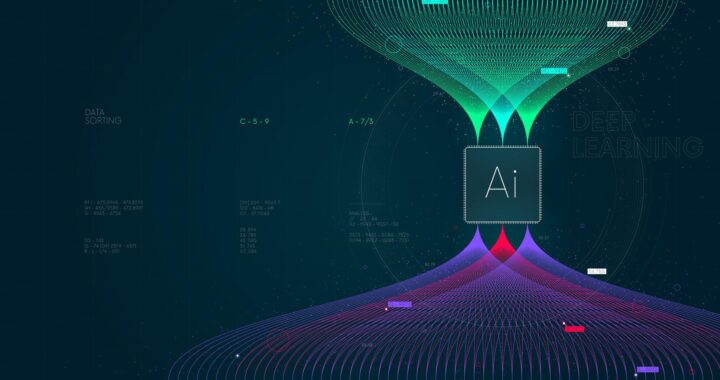
Deep learning has become one of the most influential technologies in modern artificial intelligence. It powers applications that can recognize images, understand language, analyze complex patterns, recommend content, assist with scientific research, and support increasingly sophisticated digital tools.
An aideeplearning blog can help readers understand this rapidly evolving field without requiring them to begin with advanced mathematics or complicated programming concepts. By connecting technical ideas with practical examples, deep learning becomes easier to understand and explore.
🧠 What Is Deep Learning?
Deep learning is a branch of machine learning that uses artificial neural networks containing multiple layers to process information.
Traditional computer programs generally rely on explicit instructions written by developers. Machine learning takes a different approach: algorithms can learn patterns from data and use those patterns to make predictions or classifications.
Deep learning extends this approach through multilayer neural networks. These networks can process increasingly complex representations of information as data moves through different layers.


For example, an image-recognition system might learn to identify simple visual patterns in early stages and progressively combine them into more complex representations.
The result is a technology capable of handling problems that were historically difficult for conventional software.
📊 Why Data Matters So Much
Data is one of the essential ingredients of modern deep learning.
A neural network needs examples from which it can identify patterns. The quality, quantity, and relevance of training data can strongly influence the resulting model.
Consider an image-classification system. If the goal is to recognize different types of objects, the system needs appropriate examples representing those objects across different conditions.
Poor-quality or incomplete data can create unreliable results.
This is why modern AI development involves much more than simply selecting a sophisticated neural-network architecture. Data collection, cleaning, labeling, evaluation, and governance are all important parts of the process.
For anyone learning deep learning, understanding data is therefore just as important as understanding algorithms.
💻 Neural Networks and Representation Learning


One of the most powerful ideas behind deep learning is representation learning.
Instead of requiring programmers to manually define every feature a system should examine, neural networks can learn useful representations from data during training.
In computer vision, for instance, different layers can progressively represent increasingly complex visual characteristics. In language applications, neural networks can learn relationships between words and larger patterns in text.
This ability to learn representations has contributed significantly to advances in areas such as computer vision, speech processing, and natural-language technology.
The technology is not “thinking” in exactly the same way humans do. Rather, it is performing complex mathematical transformations that allow patterns within data to be represented and used.
Understanding this distinction helps separate realistic explanations of AI from exaggerated claims.
👁️ Deep Learning and Computer Vision
Computer vision is one of the fields where deep learning has demonstrated remarkable capabilities.
Modern vision models can assist with tasks such as image classification, object detection, segmentation, and image generation.


Applications can be found across many industries.
In manufacturing, computer vision can assist with quality inspection. In agriculture, image analysis can support crop monitoring. In scientific research, AI can help researchers analyze large collections of visual information.
The technology can also support accessibility applications, such as systems designed to describe visual information for people who have difficulty seeing.
However, accuracy remains an important consideration. Real-world environments are unpredictable, and models can behave differently when presented with information that differs from their training data.
That is why testing and human oversight remain essential.
🗣️ Deep Learning and Natural Language
Another major area of deep-learning development is natural-language processing.
Language is complicated because meaning depends on context, structure, tone, cultural references, and relationships between words.
Deep-learning models have enabled significant advances in language-related tasks, including translation, summarization, text generation, speech recognition, and question answering.


Large language models are particularly prominent examples of deep-learning systems. They are trained on large collections of text and learn statistical relationships that allow them to generate responses based on prompts.
Yet fluent language does not necessarily mean perfect understanding.
AI systems can produce inaccurate information, misunderstand context, or generate confident-sounding statements that are unsupported. Users should therefore verify important claims rather than treating generated text as automatically authoritative.
⚙️ Training a Deep-Learning Model
Training is the process through which a neural network adjusts its internal parameters to improve its performance on a particular task.
During training, a model receives examples and produces predictions. Those predictions are compared with expected results, and an optimization process adjusts the model’s parameters.
This process may be repeated many times.


Modern deep-learning models can require substantial computational resources, particularly when working with very large datasets and complex architectures.
Specialized hardware, including GPUs and other accelerators, has become important for training and deploying many AI models.
The computational requirements also raise questions about energy consumption, infrastructure costs, and accessibility.
As deep learning develops, researchers continue to explore methods for making models more efficient while maintaining useful performance.
🔬 Deep Learning in Scientific Research
Deep learning is increasingly being explored as a research tool.
Scientists can use machine-learning models to identify patterns within large datasets that would be difficult to analyze manually.
Potential applications span fields such as biology, astronomy, chemistry, climate science, materials research, and medicine.


For example, researchers may use machine learning to analyze biological images, predict molecular properties, classify astronomical observations, or investigate complex scientific datasets.
The value of AI in research is not necessarily that it replaces scientists.
Instead, it can provide another analytical tool.
Researchers still need domain expertise to determine whether a model’s output is scientifically meaningful, whether the underlying data is appropriate, and how conclusions should be validated.
The strongest results often emerge when machine-learning expertise and subject-matter expertise work together.
🔐 Challenges and Responsible AI
Deep learning offers enormous possibilities, but it also introduces challenges.
Models can inherit unwanted patterns from their training data. Privacy can become an issue when sensitive information is used improperly. Complex models can sometimes be difficult to interpret. AI systems can also be deliberately misused.


Responsible development therefore requires more than improving model performance.
Developers and organizations need to consider privacy, security, fairness, transparency, reliability, and appropriate human oversight.
Users also have a role to play. Understanding the limitations of AI makes it easier to use these systems responsibly.
A good aideeplearning resource should therefore cover both technical innovation and responsible implementation.
🎓 Learning Deep Learning Step by Step
Deep learning can initially seem intimidating because it combines programming, mathematics, statistics, and computer science.
The good news is that learners do not need to master everything simultaneously.
A practical learning journey can begin with basic Python programming and fundamental concepts in data structures and algorithms. From there, learners can explore statistics, probability, linear algebra, and introductory machine learning.
Once those foundations are comfortable, neural networks become easier to understand.


Hands-on projects are particularly valuable.
A learner might begin with a simple classification project, experiment with image recognition, or build a small text-processing application. Practical experience helps transform abstract concepts into understandable processes.
The objective should not be to memorize every algorithm.
Instead, learners should understand how to frame a problem, prepare data, select an appropriate approach, evaluate results, and recognize limitations.
🚀 The Future of Deep Learning
The future of deep learning is likely to involve continued improvements in model capabilities, efficiency, multimodal systems, specialized applications, and human-AI collaboration.
Researchers are exploring models that can work with different types of information, including text, images, audio, video, and structured data.
At the same time, there is increasing interest in making AI systems more efficient, reliable, interpretable, and useful in specialized domains.


The future may not be defined simply by creating larger models.
Efficiency, reliability, safety, and practical usefulness could become equally important.
Organizations will need systems that perform useful tasks while operating within appropriate technical and ethical boundaries.
🌟 Final Thoughts
Deep learning represents one of the most important developments in modern artificial intelligence.
Its ability to learn complex patterns from data has transformed computer vision, language processing, scientific research, automation, and many other fields.
Yet deep learning is not magic.
Its performance depends on data, algorithms, computing resources, evaluation, and careful implementation. Models can make mistakes, and sophisticated technology still requires human judgment.
For students, professionals, researchers, and technology enthusiasts, learning about deep learning offers an opportunity to understand one of the technologies shaping the future of computing.
An aideeplearning blog can serve as a useful gateway into this field by connecting technical knowledge with practical applications, current developments, responsible AI principles, and accessible explanations. 🤖📚
The deeper we understand how these systems work, the better prepared we become to use them thoughtfullyand to participate in shaping what comes next. 🚀🧠