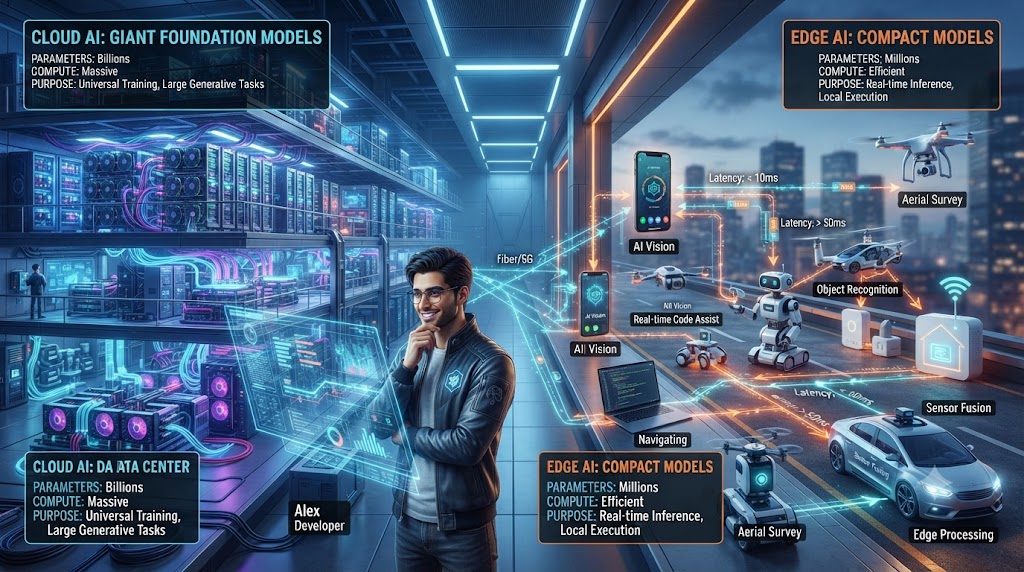
Artificial intelligence has traditionally depended on powerful cloud data centers. When people use an AI assistant, generate an image, translate a sentence, summarize a document, or analyze information, their requests often travel from a device to remote servers where sophisticated AI models perform the necessary calculations.
But a new direction is emerging.
What if AI did not need to leave your device at all?
The rapid development of smartphones, laptops, personal computers, automobiles, wearables, and specialized AI chips is making it possible to run increasingly capable artificial intelligence locally. Instead of sending every request to the cloud, devices can process some AI tasks directly using their own processors and neural processing units.
This shift is creating a new era of private on-device intelligence.
On-device AI could make artificial intelligence faster, more private, more resilient to poor connectivity, and potentially less expensive to operate at scale. It could also change the way people think about personal data. Rather than treating the cloud as the default home for intelligence, future devices may increasingly become intelligent computing environments in their own right.
The result may not be the disappearance of cloud AI. Instead, the future could involve a powerful combination of local intelligence and cloud intelligence, with devices deciding where each task should be processed.
🧠 What Is On-Device AI?
On-device AI refers to artificial intelligence models and systems that perform at least part of their computation directly on the device where the user interacts with them.
That device could be a smartphone, laptop, smartwatch, vehicle, camera, industrial machine, robot, medical device, or another connected system.
Traditional cloud AI generally follows a simple pattern. A user provides information, the device sends the information to a remote server, the cloud processes it, and the result returns to the device.
On-device intelligence changes this architecture.
The device itself contains hardware capable of running AI workloads. A processor, GPU, NPU, or dedicated AI accelerator can execute a model locally. Some systems can therefore recognize speech, classify images, translate text, summarize content, detect objects, or personalize experiences without continuously communicating with a remote server.
The intelligence becomes closer to the user.
This does not necessarily mean that an entire giant AI model is stored inside a smartphone. Many local models are considerably smaller and optimized for specific tasks.
The important concept is bringing computation closer to where data is created.
☁️ Why AI Has Traditionally Lived in the Cloud
Cloud computing became central to modern AI because advanced models require enormous computational resources.
Large language models and multimodal systems can contain billions or even trillions of parameters. Training them requires specialized data centers containing thousands of accelerators and enormous amounts of electricity and cooling infrastructure.
Cloud platforms provide access to this infrastructure.
A smartphone, by comparison, has strict limitations involving battery capacity, heat generation, memory, storage, and processing power.
Cloud AI therefore offered a practical solution. The device could remain relatively lightweight while the difficult computation happened remotely.
This architecture has enabled extremely capable AI services.
However, cloud dependence also introduces trade-offs.
Every interaction that requires a remote server may depend on network connectivity. Sensitive information may need to travel beyond the user’s device. Data-center processing can introduce latency, and large-scale AI workloads can become expensive.
As device hardware becomes more capable, the balance is changing.
🔒 Privacy Is Becoming a Major Reason to Run AI Locally
One of the most important arguments for on-device AI is privacy.
Consider an AI assistant that understands a person’s calendar, messages, photos, voice recordings, documents, location patterns, and daily habits.
That information can reveal an extraordinary amount about an individual.
If AI processing happens locally, sensitive information can potentially remain on the device instead of being routinely uploaded to remote infrastructure.
For example, a smartphone might locally identify important notifications, summarize personal notes, organize photographs, or process a voice command without transmitting the raw content to a server.
This creates an attractive privacy model:
Data is generated locally → AI processes it locally → useful result remains local.
Of course, local processing does not automatically guarantee privacy. Applications still need appropriate security controls, permissions, encryption, secure storage, and responsible data practices.
But reducing unnecessary data transmission can significantly change the privacy equation.
⚡ Speed: Intelligence Without Waiting for the Internet
Another major advantage is latency.
When an AI request travels to a remote server, several steps occur. The request must leave the device, reach a server, be processed, and return with the answer.
For many applications, this delay is acceptable.
For others, milliseconds matter.
Imagine a vehicle detecting an obstacle. A manufacturing robot identifying a dangerous situation. A smartphone translating speech during a conversation. A wearable monitoring movement. A security camera detecting an event.
These systems may benefit from immediate local decisions.
On-device processing can eliminate or reduce network round trips.
This does not mean every local AI system will always be faster than a cloud model. Large cloud systems have enormous computing resources. But for appropriately sized models and specific tasks, local inference can be extremely responsive.
The result is an AI experience that feels less like contacting a remote service and more like using a built-in capability of the device.
📱 Smartphones Are Becoming AI Computers
The smartphone is likely to be one of the most important platforms for on-device intelligence.
Modern mobile processors increasingly include dedicated hardware designed to accelerate machine-learning operations.
Instead of treating AI as an application that always requires a remote service, manufacturers can integrate AI capabilities directly into the operating system.
A phone could potentially use local intelligence for tasks such as:
- Voice recognition
- Photo organization
- Image enhancement
- Text summarization
- Translation
- Writing assistance
- Personal recommendations
- Accessibility features
- Notification management
- Document analysis
- Camera scene understanding
The smartphone could gradually become a personal AI computer rather than simply a communication device.
And because smartphones remain close to their owners throughout the day, they are uniquely positioned to provide personalized intelligence.
💻 Laptops and PCs Are Joining the AI Shift
The on-device AI movement is not limited to phones.
Personal computers are increasingly incorporating dedicated AI acceleration hardware.
This creates opportunities for AI features that operate locally on laptops and desktops.
A computer could summarize a document without sending it to an external service. A developer could use a local coding model. A creative professional could run image-processing tools directly on a workstation. A business could deploy specialized AI applications without sending sensitive information outside its infrastructure.
For organizations, this can be particularly important.
Companies often handle confidential contracts, financial information, intellectual property, customer records, engineering designs, and internal communications.
Running selected AI workloads locally or within controlled infrastructure could reduce the amount of sensitive information that needs to reach third-party AI services.
🧩 Small Models Are Making Local AI Possible
One of the biggest technological developments behind on-device intelligence is the rise of smaller AI models.
The AI industry has demonstrated that bigger models can deliver remarkable general-purpose capabilities. But larger is not always better for every task.
A model designed specifically for speech recognition does not necessarily need the same scale as a general-purpose reasoning system.
A model designed to detect objects in a camera feed can be highly specialized.
A model designed to summarize short notifications can be much smaller than one designed for complex research.
This has created an ecosystem of compact AI models optimized for efficiency.
Techniques such as quantization, pruning, knowledge distillation, low-rank adaptation, and architectural optimization can reduce computational requirements while preserving useful capabilities.
The goal is not to create the largest possible model.
The goal is to create the smallest model that can perform the required task effectively.
🔋 Battery Life Is One of the Biggest Challenges
On-device intelligence has an important limitation: energy.
Cloud data centers can consume enormous amounts of electricity, but individual devices have tiny energy budgets in comparison.
A smartphone must balance AI performance with battery life.
If an AI model consumes too much power, users may experience faster battery drain and increased device temperatures.
This means hardware and software designers must optimize AI workloads carefully.
Dedicated AI accelerators can help because they are designed to perform certain mathematical operations more efficiently than general-purpose processors.
Software optimization also matters.
AI systems can determine when computation is necessary and when simpler techniques are sufficient.
A future device may therefore use a combination of lightweight models, hardware acceleration, caching, and selective cloud processing to reduce energy consumption.
🌐 AI That Works Without an Internet Connection
One of the most practical benefits of local AI is offline functionality.
Imagine traveling through an area with weak connectivity.
A cloud-dependent AI assistant may become unavailable or severely limited.
An on-device system could continue operating.
Offline AI could be particularly valuable for:
Travelers navigating remote areas, workers in industrial environments, emergency responders, field researchers, rural communities, and people living in regions with unreliable internet connectivity.
Offline translation is another interesting example.
A language model stored on a device could potentially translate common phrases without requiring a network connection.
Similarly, a device could provide basic accessibility features, speech recognition, or document assistance even when disconnected.
This gives AI a new characteristic:
Resilience.
AI does not have to stop simply because the internet does.
🏭 On-Device AI in Factories
Industrial environments may benefit significantly from local intelligence.
Factories increasingly use cameras, sensors, robots, machines, and automated inspection systems.
Sending every sensor reading and camera frame to the cloud can be inefficient.
An edge AI system can analyze information near the production line.
For example, a manufacturing camera could identify a defective component locally.
A machine could detect abnormal vibration patterns.
A robotic system could recognize an object and adjust its movement.
An industrial controller could detect a potentially dangerous condition without waiting for a remote server.
This architecture can reduce latency and network traffic while allowing organizations to maintain tighter control over operational data.
🚗 Vehicles Are Becoming Intelligent Edge Computers
Modern vehicles contain dozens of sensors and increasingly sophisticated computing systems.
Cameras, radar, microphones, GPS systems, and other sensors continuously generate information.
For advanced driver-assistance systems, processing some information locally is essential because decisions may need to happen extremely quickly.
A vehicle cannot depend entirely on a distant data center to determine whether an obstacle is directly in its path.
Local AI can analyze sensor information in real time.
Cloud services can still contribute other capabilities, such as software updates, fleet analytics, mapping improvements, and large-scale data processing.
This demonstrates an important principle of future AI architecture:
The cloud and the device do not have to compete. They can cooperate.
🏠 Smart Homes Could Become More Private
Smart-home devices have traditionally depended heavily on cloud connectivity.
Cameras, microphones, smart speakers, thermostats, and security systems can generate highly sensitive information about household activities.
Local AI could allow some of these systems to make decisions without continuously uploading raw data.
For example, a smart camera might detect whether an object is present without sending every video frame to the cloud.
A voice assistant might recognize certain commands locally.
A home automation system could learn patterns while keeping some personal information inside the home network.
This could make intelligent homes more privacy-conscious.
🧑⚕️ Healthcare and Personal Devices
Healthcare is another area where local AI could become important.
Wearable devices can collect information about movement, sleep patterns, heart activity, exercise, and other physiological signals.
Processing some information locally could reduce unnecessary transmission of personal data.
Local AI might help classify activity patterns, detect unusual signals, or provide immediate feedback.
However, healthcare applications require especially careful validation.
An AI model running on a wearable should not automatically be treated as a medical diagnostic system. Clinical reliability, regulatory requirements, security, and human oversight remain critical.
Still, the technical possibility of processing health-related signals close to the person is significant.
🛡️ Cybersecurity Benefits—and New Risks
On-device AI can strengthen cybersecurity in some situations.
Local models can monitor activity, identify suspicious patterns, and respond rapidly.
A security system could detect unusual application behavior without constantly sending raw information to a remote service.
But local AI also creates new security challenges.
If an attacker compromises a device, they may attempt to manipulate its AI model or extract information from it.
Models themselves can become valuable targets.
There are also concerns around malicious inputs, model theft, data poisoning, and adversarial attacks.
Therefore, private AI requires strong hardware and software security.
Secure boot systems, encrypted storage, permission controls, model protection, trusted execution environments, and regular security updates could become increasingly important.
🧠 Personal AI Could Become More Personal
Perhaps the most interesting consequence of on-device AI is personalization.
Cloud AI generally serves many users through shared infrastructure.
A local AI system can potentially become deeply customized to one individual.
It could understand personal writing preferences, frequently used applications, recurring schedules, commonly accessed files, and preferred workflows.
Instead of simply asking an AI assistant questions, users could gradually develop a personal intelligence layer that understands their digital environment.
For example, a local AI could help organize files based on personal habits.
It could identify frequently used information.
It could understand how a person typically writes emails.
It could prioritize notifications according to individual behavior.
It might even anticipate routine tasks.
This raises an important question:
Who owns the intelligence that learns about you?
With local AI, the answer could increasingly be the individual and their device rather than a remote platform.
🤖 Local AI Agents Could Change Computing
The rise of AI agents makes on-device intelligence even more interesting.
An AI agent is not simply a chatbot that responds to questions. It can potentially interpret a goal, plan actions, interact with applications, and complete tasks.
A local AI agent could operate directly within a person’s computer or smartphone environment.
Imagine saying:
“Find my travel documents, summarize the important details, and create a checklist.”
A local agent could search files, understand documents, organize information, and create the requested output.
Another example could be:
“Show me the photographs from last year’s trip and organize the best ones.”
Much of this work could potentially happen directly on the device.
The result is a shift from AI as a website to AI as part of the operating system.
☁️ The Cloud Is Not Going Away
Despite the growth of local AI, cloud computing remains extremely important.
Large models require enormous computational resources.
Complex reasoning tasks may exceed the capabilities of a phone or laptop.
Cloud systems can also provide continuously updated models and access to huge datasets.
Therefore, the likely future is not “cloud versus device.”
It is cloud plus device.
A smartphone could perform simple or sensitive tasks locally while sending complex requests to a cloud model.
This architecture is sometimes described as a hybrid AI system.
The device becomes the first layer of intelligence.
The cloud becomes a more powerful secondary layer.
🔀 Intelligent Model Routing
Future operating systems could automatically determine where a task should be processed.
Suppose a user asks a simple question.
The device could answer locally.
If the request involves private information, the system might prioritize local processing.
If the task requires advanced reasoning, the system could securely send selected information to a cloud model.
This creates an intelligent routing system.
The decision could consider:
- Privacy requirements
- Model capability
- Battery level
- Network availability
- Processing speed
- Cost
- Data sensitivity
- User preferences
Instead of users manually choosing between local and cloud AI, the operating system could make the decision automatically.
🌍 On-Device AI Could Expand Access to Intelligence
Another important possibility is global accessibility.
Cloud AI requires reliable internet access and supporting infrastructure.
Local AI can operate with less connectivity.
This could make useful AI capabilities available in places where high-speed internet is limited or expensive.
Smaller models also make it possible to create AI systems for specialized languages and regional applications.
For countries with diverse linguistic environments, local AI could support translation, education, accessibility, and digital services in ways that are tailored to specific communities.
This could be particularly important as AI moves beyond a small number of dominant languages.
💰 The Economics of Local AI
Running AI in the cloud can be expensive at massive scale.
Every AI interaction requires computing resources, and millions or billions of requests can generate substantial infrastructure costs.
On-device inference changes the economics.
Once the required hardware is already inside a device, some AI operations can occur without requiring a separate cloud computation for every request.
This does not make AI free. Hardware development, software engineering, model development, electricity, updates, and security still have costs.
But it can change how those costs are distributed.
The business model of AI may therefore evolve from purely subscription-based cloud services toward a combination of hardware, software, premium cloud capabilities, and local intelligence.
⚙️ The Hardware Race Is Changing
The AI hardware industry has traditionally focused heavily on data-center accelerators.
Now another competition is developing.
Companies are designing processors that can perform AI workloads efficiently inside consumer devices.
Neural processing units are becoming increasingly important.
Future smartphones, laptops, cars, cameras, and robots may compete partly on their AI processing capabilities.
Instead of asking only how fast a device’s CPU is, consumers may increasingly ask:
“How powerful is its local AI?”
This could make AI acceleration as fundamental to consumer hardware as graphics processing became during the rise of modern visual computing.
🔐 A New Privacy Contract Between People and Technology
On-device AI could ultimately change expectations about personal data.
For decades, digital services have often been built around collecting information and processing it remotely.
Local intelligence offers another philosophy:
Keep more computation close to the user.
This does not eliminate data collection.
But it creates the possibility of minimizing unnecessary transfers.
Users may increasingly expect devices to explain:
What information is processed locally?
What information leaves the device?
Which AI models are being used?
What data is stored?
How long is it retained?
Can the user disable cloud processing?
These questions could become important parts of digital privacy standards.
🚧 What Are the Limitations?
On-device AI is promising, but it has real constraints.
The first is computational power. A smartphone cannot compete directly with a massive data center for every AI workload.
The second is memory. Large models can require significant amounts of storage and RAM.
The third is energy consumption.
The fourth is model updating. Cloud models can be updated centrally, while local models may need to be downloaded and installed across millions of devices.
The fifth is security.
And finally, local models may simply be less capable than their largest cloud counterparts.
These limitations mean that the industry will likely continue developing hybrid architectures rather than abandoning cloud computing.
🔮 What Could the Next Five Years Look Like?
Over the coming years, local AI may become increasingly invisible.
Users may not even think about whether a particular AI request is processed locally or remotely.
The operating system could automatically make that decision.
Smartphones may contain increasingly capable personal models.
Laptops may provide local AI assistants capable of understanding files and applications.
Cars may use local models for increasingly sophisticated perception.
Wearables may process more information directly.
Industrial systems may perform real-time AI analysis without sending every sensor reading to the cloud.
Home devices may become more privacy-focused.
And personal AI agents may operate as persistent software layers across devices.
The defining characteristic could be distributed intelligence.
AI will no longer exist in one place.
It will exist across devices, edge servers, private networks, and cloud data centers.
🌐 The Bigger Vision: Intelligence Everywhere
The most significant consequence of on-device AI may not be the disappearance of cloud computing.
It may be the distribution of intelligence.
Today, much of the world’s AI capability is concentrated in large data centers.
Tomorrow, intelligence could be distributed across billions of devices.
Phones could have personal AI.
Cars could have automotive AI.
Factories could have industrial AI.
Homes could have private AI.
Robots could have autonomous AI.
Wearables could have health-oriented intelligence.
Computers could have local digital agents.
Each device could become a small intelligent computing environment.
Together, these systems could form a vast decentralized layer of machine intelligence.
🧭 Conclusion: The Future of AI May Be Closer Than We Think
The next stage of artificial intelligence may not simply be about building larger models.
It may also be about putting the right intelligence in the right place.
Cloud AI will continue to provide extraordinary computational power. But increasingly capable chips, smaller models, better optimization techniques, and growing privacy expectations are creating a strong case for local intelligence.
AI without the cloud does not mean a world without cloud computing.
Instead, it points toward a hybrid future where devices handle tasks that benefit from privacy, speed, resilience, and personalization, while cloud systems handle tasks that require enormous computational resources.
The most important AI system of the future may therefore not be a single giant model sitting in a data center.
It may be an intelligent network of models distributed across the devices people use every day.
And when that happens, artificial intelligence will not always feel like something we access.
It may simply feel like something our devices are. 🤖📱🔒
🎨 Feature Image Prompt
A futuristic smartphone, laptop, smartwatch, car, and smart-home devices processing artificial intelligence locally without cloud servers, glowing neural processing circuits inside each device, privacy shield symbols, secure data staying within devices, subtle edge-computing network, cinematic technology environment, realistic 3D rendering, blue and violet digital atmosphere, highly detailed, modern AI concept, 16:9
🔍 SEO Details
Meta Title: AI Without the Cloud: The Rise of Private On-Device AI
Meta Description: Discover how on-device AI is transforming privacy, speed, offline intelligence, smartphones, PCs, vehicles, robotics, and the future of personal artificial intelligence.
Suggested Slug: ai-without-the-cloud-private-on-device-intelligence
Tags: Artificial Intelligence, On-Device AI, Edge AI, Private AI, AI Technology, Local AI, AI Privacy, AI Chips, Neural Processing Units, AI Agents, Cloud AI, Future of AI, Smartphone AI, Personal AI, Machine Learning