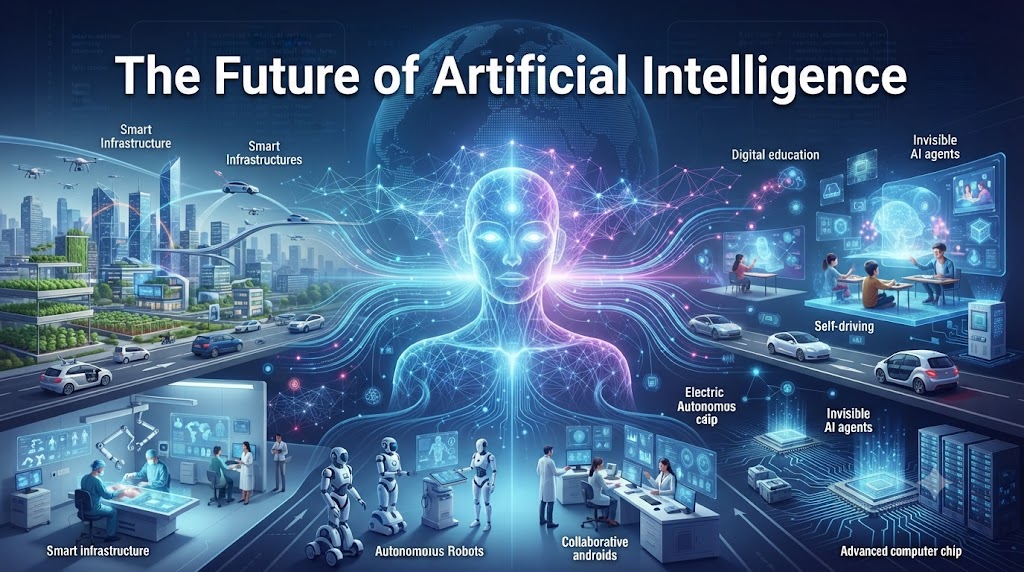
Artificial Intelligence (AI) is moving from a specialized technology into a fundamental part of modern life. Over the next decade, AI could influence how people work, learn, communicate, travel, receive healthcare, and interact with digital services. Advances in machine learning, robotics, computing infrastructure, and generative AI are likely to make intelligent systems more capable and more widely accessible.
The future of AI will not be defined by one breakthrough alone. Instead, several interconnected trends could shape the technology and determine how it is adopted across industries and societies.
1. The Rise of AI Agents
One of the most important developments could be the growth of AI agents. Unlike traditional chatbots that mainly respond to individual prompts, AI agents can be designed to complete multi-step tasks, use software tools, analyze information, and work toward specific objectives.
In the workplace, an AI agent might organize meetings, summarize documents, prepare reports, monitor business processes, or assist with software development. Consumers could use personal agents to manage schedules, compare information, plan trips, or automate routine digital activities.
As agent technology improves, the focus may shift from simply asking AI questions to delegating entire workflows to AI systems.
2. More Powerful Multimodal AI
Future AI systems are likely to become increasingly multimodal. Instead of working primarily with text, advanced models can combine information from images, audio, video, documents, and other forms of data.
This could make AI interactions much more natural. For example, a student might show an AI a mathematical problem and receive a visual explanation. A technician could provide a video of a machine and receive assistance identifying potential issues. Businesses could analyze text documents alongside charts, photographs, recordings, and video.
Multimodal capabilities could therefore make AI useful in situations where information exists in many different formats.
3. AI in Healthcare
Healthcare is another field where AI could experience significant growth. AI systems may increasingly assist doctors and medical professionals with medical-image analysis, documentation, research, patient monitoring, and administrative tasks.
AI could also accelerate drug discovery by helping researchers analyze biological information and identify promising candidates for further investigation.
However, healthcare AI will require careful validation, privacy protections, human oversight, and appropriate regulation. AI-generated information should not automatically be treated as a substitute for qualified medical professionals.
4. Personalized AI Assistants
The next generation of AI assistants could become more personalized than today’s general-purpose systems. With appropriate privacy controls, assistants may understand a user’s preferences, routines, goals, and communication style.
Instead of repeatedly explaining the same context, users could interact with an assistant that remembers relevant information across tasks. This could create a more continuous relationship between people and their digital tools.
At the same time, personalization raises important questions about data ownership, privacy, security, and user control.
5. AI-Powered Robotics
AI is increasingly connecting software intelligence with physical machines. Improvements in computer vision, sensors, language models, and robotic control could contribute to more capable robots.
Future robots could potentially support manufacturing, logistics, agriculture, healthcare, construction, household tasks, and dangerous industrial operations.
The biggest challenge will not simply be making robots intelligent. They must also become reliable, safe, affordable, energy-efficient, and capable of operating in unpredictable physical environments.
6. AI at the Edge
AI processing may increasingly move from centralized cloud servers toward devices themselves. This trend, often called edge AI or on-device AI, could allow smartphones, computers, vehicles, cameras, and other devices to perform more AI tasks locally.
Local processing can potentially reduce latency and improve privacy because some information does not need to be continuously transmitted to remote servers.
As specialized AI chips become more powerful and energy-efficient, sophisticated AI features could become standard components of everyday devices.
7. AI-Driven Scientific Discovery
AI could become an important research partner across scientific disciplines. Researchers can use computational models to analyze enormous datasets, identify patterns, generate hypotheses, and simulate complex systems.
Fields such as materials science, climate research, biology, chemistry, astronomy, and physics could benefit from increasingly capable AI tools.
The long-term possibility is particularly significant: AI could help scientists explore problems that are too complex or data-intensive for conventional approaches alone.
8. The Transformation of Work
AI is likely to change many jobs rather than simply eliminate or create them in a straightforward way. Routine digital tasks may become increasingly automated, while human workers may spend more time on judgment, creativity, communication, strategy, and relationship-building.
Many professions could develop new AI-assisted workflows. Employees may increasingly need to understand how to evaluate AI outputs, supervise automated systems, and collaborate effectively with AI tools.
This could make AI literacy an important professional skill across industries.
9. Greater Focus on AI Safety and Governance
As AI systems become more capable, safety and governance will become increasingly important. Governments, technology companies, researchers, and international organizations are exploring questions surrounding privacy, transparency, security, copyright, accountability, and responsible deployment.
Future AI development may involve stronger evaluation systems, monitoring mechanisms, documentation requirements, and safeguards for high-risk applications.
The challenge will be balancing technological innovation with measures designed to reduce foreseeable harms without unnecessarily preventing beneficial uses of AI.
10. More Efficient and Specialized AI Models
The future may not consist entirely of increasingly large AI models. Researchers are also working toward smaller, faster, and more efficient systems that can perform specific tasks effectively.
Specialized models could be particularly valuable for businesses that need predictable performance, lower operating costs, stronger privacy, or deployment on local hardware.
This could lead to a diverse AI ecosystem containing enormous general-purpose models alongside compact models designed for particular industries and applications.
11. AI-Powered Education
Education could become increasingly personalized through AI. Intelligent tutoring systems may adapt explanations, exercises, and learning materials to individual students.
Teachers could use AI to create educational resources, analyze learning patterns, provide feedback, and reduce administrative workloads.
The human role will remain important, particularly because education involves motivation, social interaction, mentorship, creativity, and emotional development—not simply the delivery of information.
12. The Growth of Human-AI Collaboration
Perhaps the most significant trend will be the development of better collaboration between humans and AI.
Rather than viewing AI purely as a replacement for human workers, organizations may increasingly use it as a tool for expanding human capabilities. A designer can use AI to explore concepts, an engineer can use it to analyze alternatives, and a researcher can use it to process large quantities of information.
The most productive future may involve humans providing goals, context, judgment, and accountability while AI assists with analysis, generation, and repetitive work.
Conclusion
The next decade could be a defining period for artificial intelligence. AI agents, multimodal systems, personalized assistants, robotics, edge computing, scientific discovery, healthcare applications, and AI-powered education are among the trends that could reshape technology and society.
Yet technological capability alone will not determine the future. Privacy, safety, regulation, accessibility, education, and responsible human oversight will also influence how AI develops.
The future of artificial intelligence is therefore unlikely to be simply about creating smarter machines. It will also be about determining how humans choose to use increasingly capable technology and how society can ensure that its benefits are broadly and responsibly realized.