Artificial Intelligence in 2026 is undergoing a structural shift that is changing how people interact with technology. The industry is moving away from simple conversational tools and toward systems that can independently plan, decide, and execute tasks. This evolution is reshaping software, devices, and digital workflows across industries.
1. From Chatbots to Autonomous AI Agents
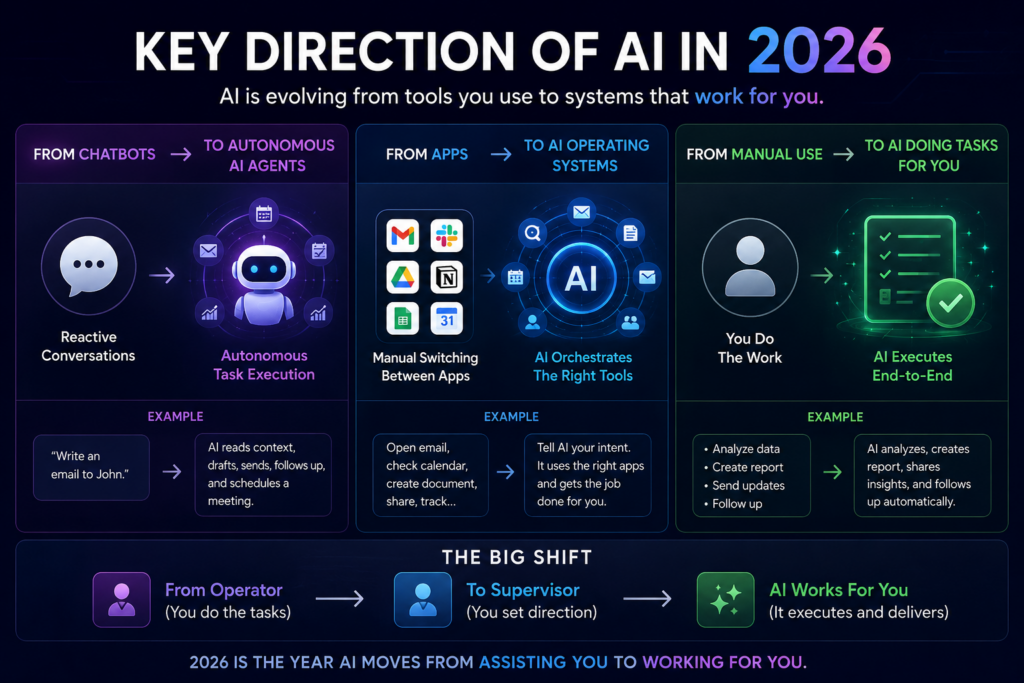
The first major transformation is the move from reactive chatbots to autonomous AI agents.
Earlier AI systems were designed mainly for conversation—users asked questions, and the system responded. In 2026, the focus is on AI that can complete multi-step objectives with minimal human input.
For example, instead of just writing an email, modern AI agents can:
- Analyze inbox context
- Draft and send responses
- Schedule meetings
- Follow up automatically
- Adjust communication style based on user behavior
Companies such as OpenAI, Google, and Meta are actively developing agent-based systems that can operate across apps and tools, making AI more like a digital worker than a chatbot.
2. From Apps to AI Operating Systems
The second shift is the emergence of AI operating systems.
Traditionally, users manually switch between apps like email, documents, spreadsheets, and messaging tools. In the new model, AI becomes a coordination layer that sits above all applications.
Instead of opening apps individually, users will:
- State an intention (“organize my trip” or “prepare my report”)
- Let the AI choose the right tools
- Allow the system to execute tasks across multiple platforms
This turns computing from an app-centric model into an intent-driven system, where the AI acts as the central interface.
3. From Manual Work to AI Execution
The third major change is the shift from manual digital work to AI-driven execution.
AI is no longer limited to suggestions or assistance. It is increasingly capable of performing complete workflows such as:
- Managing customer support conversations
- Running marketing campaigns
- Monitoring systems and fixing errors
- Handling scheduling, reminders, and coordination
- Automating data analysis and reporting
In this model, humans move from performing tasks to supervising outcomes. AI handles execution while humans guide direction and review results.
4. The Core Trend: Intelligence as Infrastructure
Across all these shifts, one idea stands out:
AI is becoming infrastructure, not just software.
Instead of being a tool you open, AI is becoming a layer embedded in every digital system—understanding intent, coordinating tools, and completing actions across platforms.
This is why companies are investing heavily in agent frameworks, multimodal models, and persistent memory systems that allow AI to behave more like an ongoing assistant than a one-time responder.
Conclusion
The direction of AI in 2026 can be summarized in three transformations:
- Chatbots → Autonomous agents
- Apps → AI operating systems
- Manual use → AI execution of tasks
This evolution marks a shift from interaction to automation. The most important change is not just smarter AI, but AI that actively works on behalf of humans.